Philadelphia College of Osteopathic Medicine, Donor Recognition Signage
March 4th, 2025

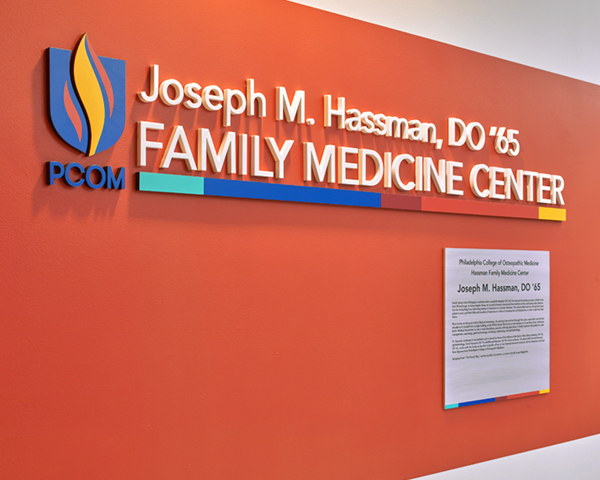
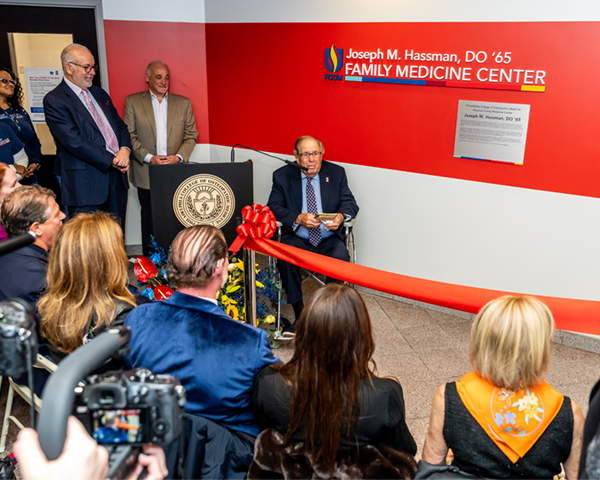
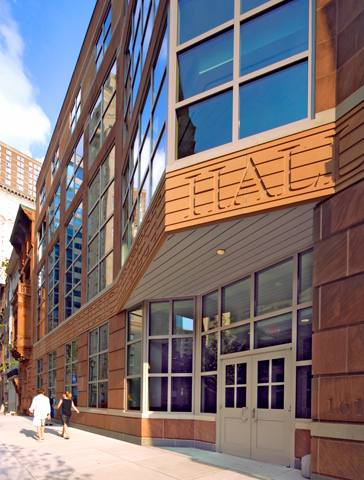
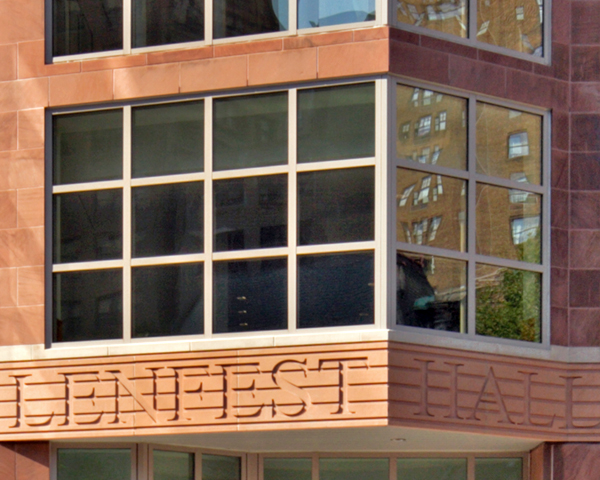
PCOM asked us to very quickly design building signage to honor the donation of a prominent alumnus. Our work was to adorn exterior as well as interior surfaces and span a wide variety of types and sizes — including signage to rededicate two major campus buildings.
Signage and communication has always been fundamental to VSBA’s approach, especially for academic campuses. Prominent donor recognition signage both celebrates an important contribution and serves the communicative needs of the campus community, so we believe it should be artistically crafted but clear, legible, and distinct.
At PCOM, our designs built on building signage we had created for Meta Christy House, working toward what might someday become campus design standards for signage.
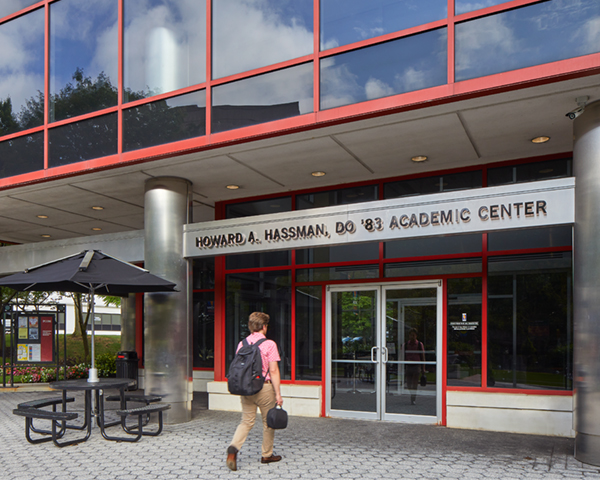
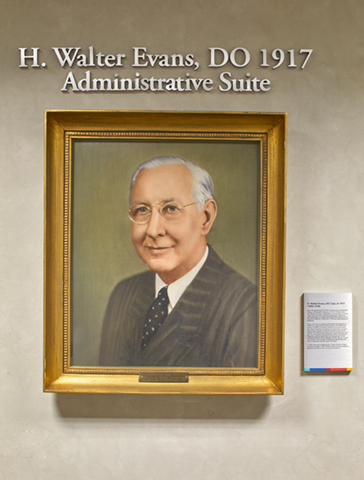
Our designs for the Hassman Academic Center (formerly Evans Hall) included a new exterior building entry sign, lobby dedication text, donor dedication plaque, and lettering / plaque for a portrait at the entrance to their administrative suite.
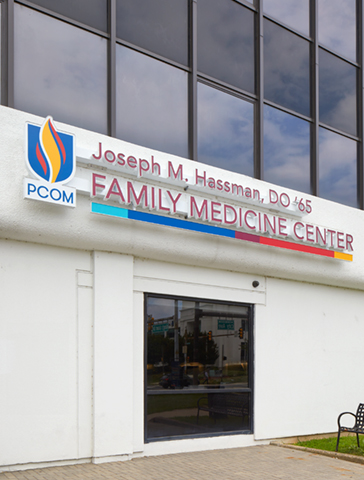
For the Hassman Family Medicine Center (formerly Rowland Hall), our designs included a large illuminated exterior building entry sign, reception desk signs, and prominent wall text and plaque at the elevator landing.
May 24th, 2022

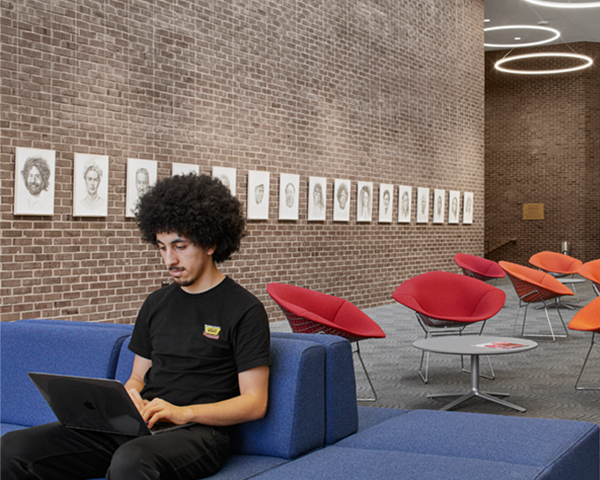
VSBA worked with the University of Pennsylvania to create a home for The Sachs Program for Arts Innovation (SPAI) at the Annenberg Center for the Performing Arts. SPAI’s goal is to stimulate advances in the study, teaching, and development of the arts. Formerly an underused space without much comfort or amenity, the new Arts Lounge is now a wonderful place to view art, attend a concert, study, practice a play, or just hang out.
Penn’s Annenberg Center for the Performing Arts is both a public venue — offering a full event schedule for Penn Live Arts — and an educational facility for the campus’s theatre arts department. SPAI’s goal is to stimulate advances in the study, teaching, and development of the arts. It’s helping to foster collaboration across disciplines and between venues while serving as an information nexus extending the arts across campus and into the city. We collaborated with a complex client team made up of representatives from SPAI, the Annenberg Center, and the theatre arts.
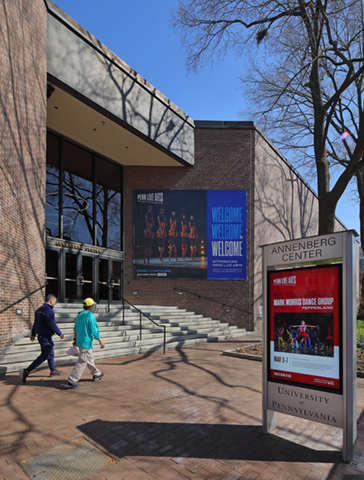
The 1971 building at 37th and Walnut Streets features high windowless masonry walls. It has several entries, but they were half-hidden, dark, and undistinguished. So our main challenge was: how can we overcome the building’s opaque facades and entries to promote activities and identity — and accomplish this through very strategic changes on a tight budget?
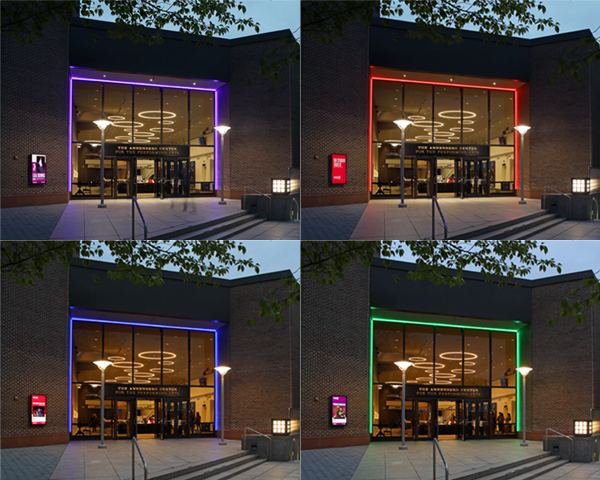
To do this, we worked from both the outside-in and the inside-out. Outside, we traced the shadowed entries with changing multicolored marquee light strips that cycle through bright, saturated colors. Nearby, new digital kiosks and wall-mounted screens offer info about events and activities. Entries are now beacons to people on and off campus. We also added fresh building signage, improved lighting on Annenberg Plaza, and improved circulation at the 37th Street entrance.
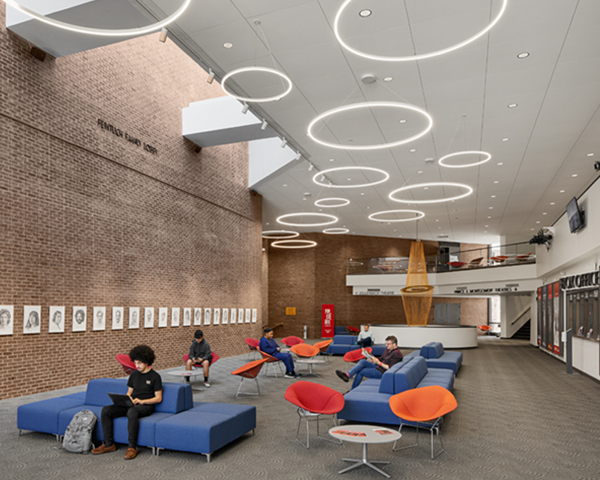
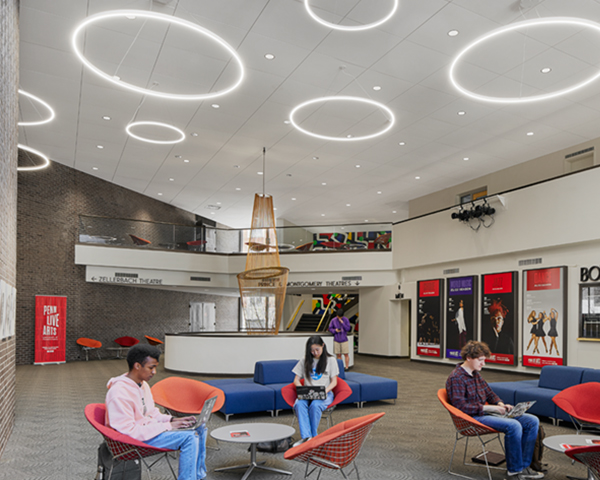
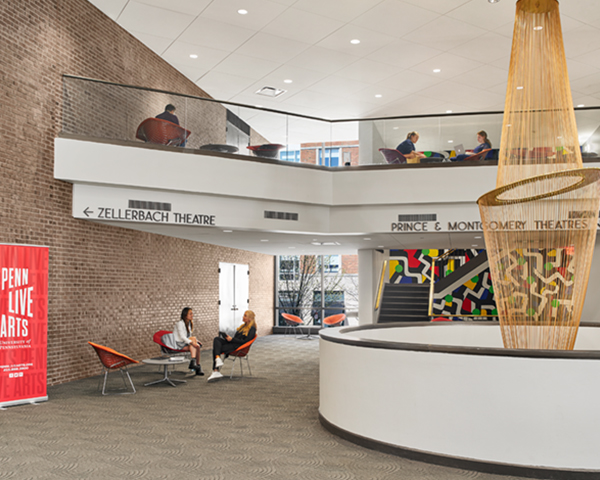
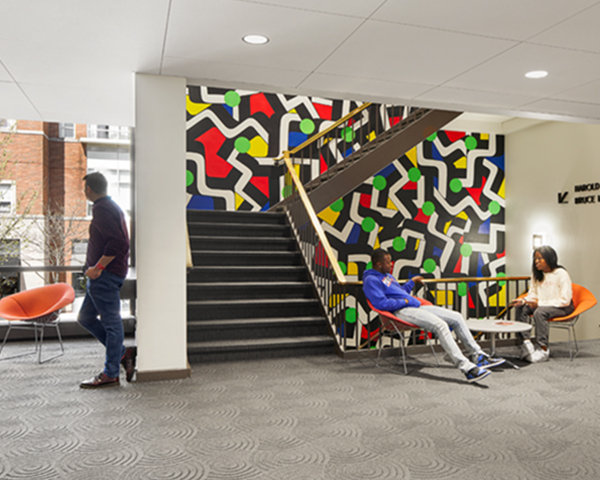
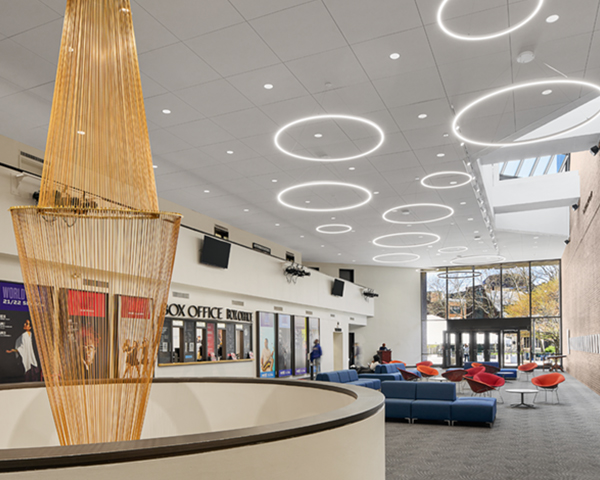
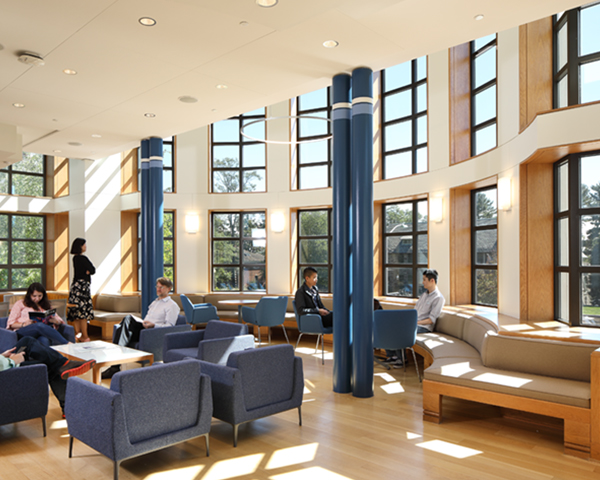
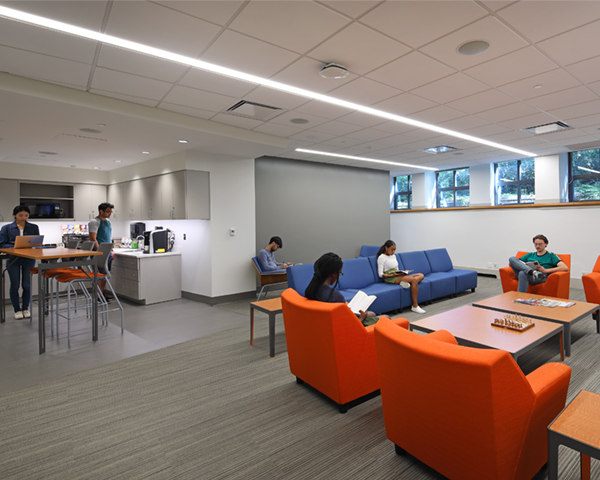
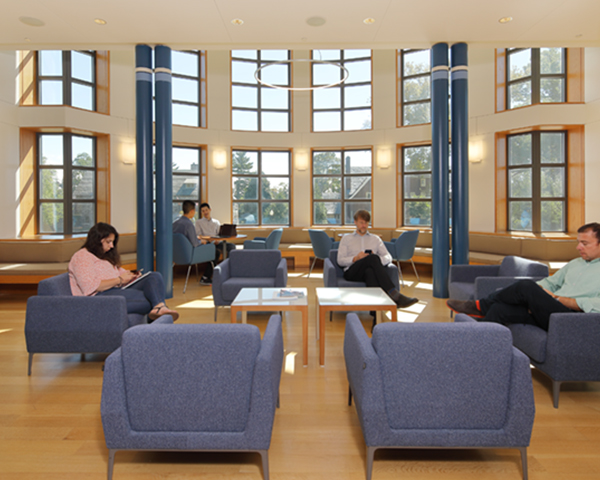
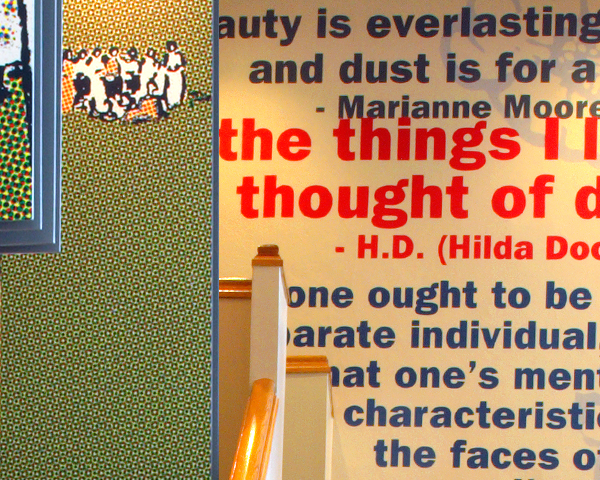
Inside, we transformed an uninspiring lobby atrium into an exciting new Arts Lounge. We added colorful furniture — deep blue settees, lively orange and red loungers, and low tables. Because ever-changing programs demand a variety of configurations, furniture can easily be rearranged to serve group gathering, gallery, presentation, performance, and other needs. Refreshment is offered through mobile coffee / snack carts and a prep kitchen. To draw people through the space, a vibrant new stair mural was also added during our renovations.
To transform one large masonry wall into a powerful space for art, we added a new gallery wall hanging system, track lights for the art, and theatrical spotlights. A new video server communicates with both the Arts Lounge screens and kiosks outside. Along the mezzanine, we replaced part of a low concrete wall with a glass railing, encouraging people up from the Arts Lounge to a cozy mezzanine area serving the theater department, SPAI offices, and others studying and hanging out.
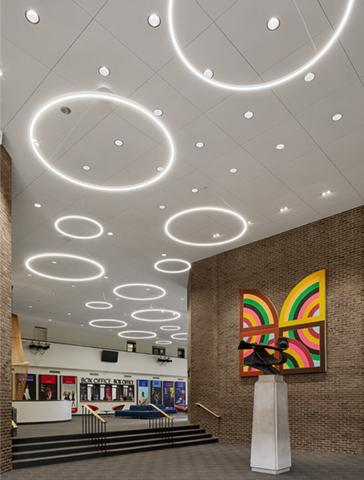
Maybe most expressively, VSBA lit the Arts Lounge with a system of light rings at a variety of sizes that extend through the lobby, connecting the Annenberg Plaza and 37th Street entries. These temper the scale of the tall space, making it feel warm and inviting. At night, the glowing hoops draw visitors in; from the inside, they’re reflected in the large entry glass panes, appearing to flow into the distance…
December 7th, 2021

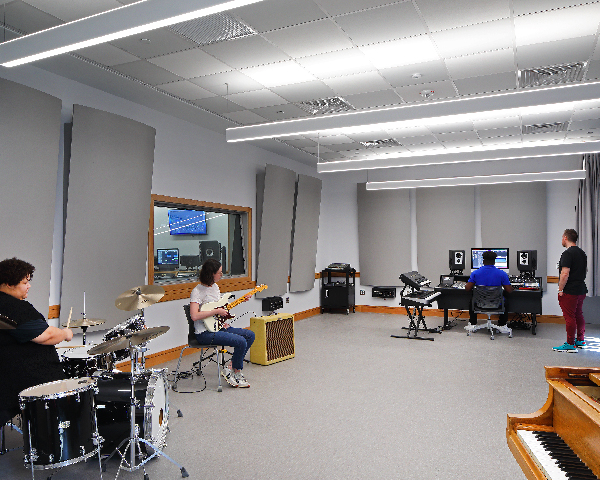
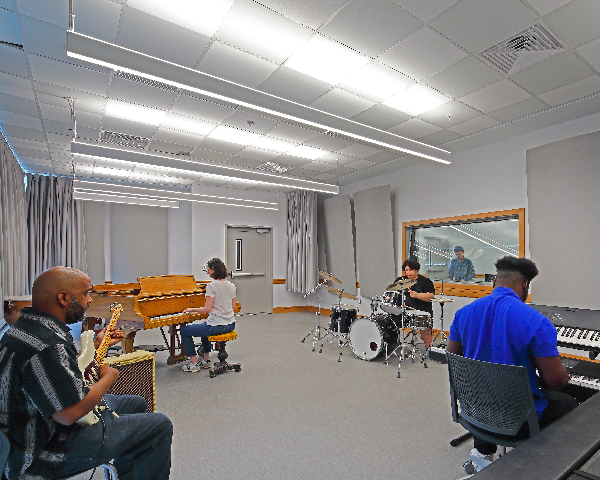
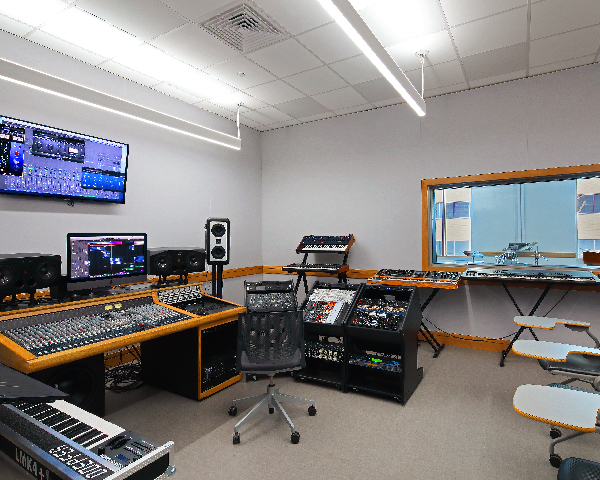
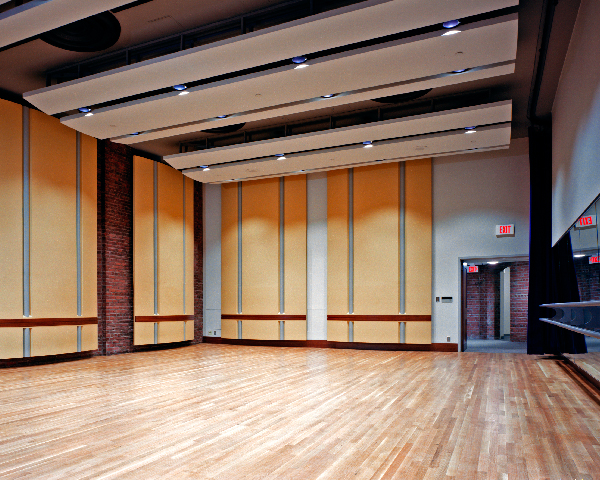
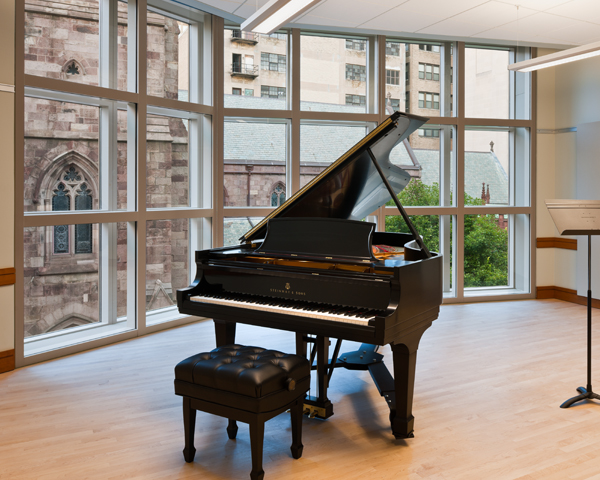
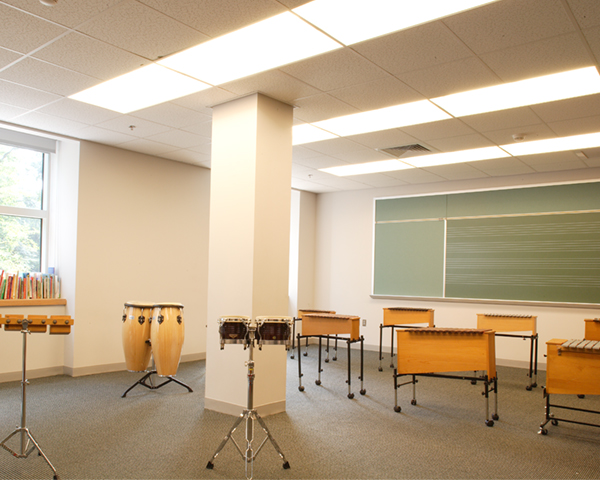
VSBA was retained by the Community College of Philadelphia (CCP) to renovate its music education, practice, and recording facilities.
CCP’s music department is located in its historic main building, a gorgeous turn-of-the-century currency mint. The building — constructed of steel, stone, concrete, terracotta, and plaster — was effective for its original machinery and operations. But noise transmits easily through the structure, so it’s not ideal when adapted for music instruction.
Previous renovations to the music department’s live and control rooms included minimal acoustic design strategies to use these spaces as education and rehearsal rooms. This proved not to be very practical for recording, editing, or working with small groups of students.
Before VSBA became involved with the project, CCP worked with an acoustician to program these spaces, establish acoustical criteria, and develop assemblies to achieve them. Collaborating with the acoustician and working from their recommendations, VSBA then developed and documented the related architectural design.
In general, we tried to maximize the performance of walls, ceilings, windows, doors, plumbing, and mechanical systems by acoustically decoupling each space from outside influences. For example, the flooring is bonded to rubber isolation mats to economically minimize footfall and other percussive noise transmission between the two rooms and adjacent spaces. And we finished the rooms with subdued acoustic wall fabrics and durable oak trim.
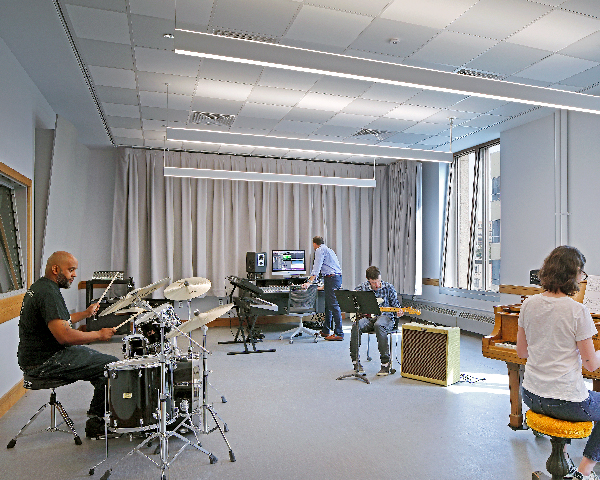
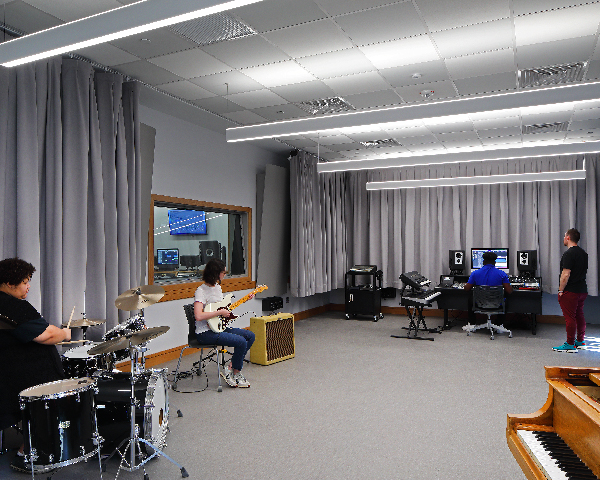
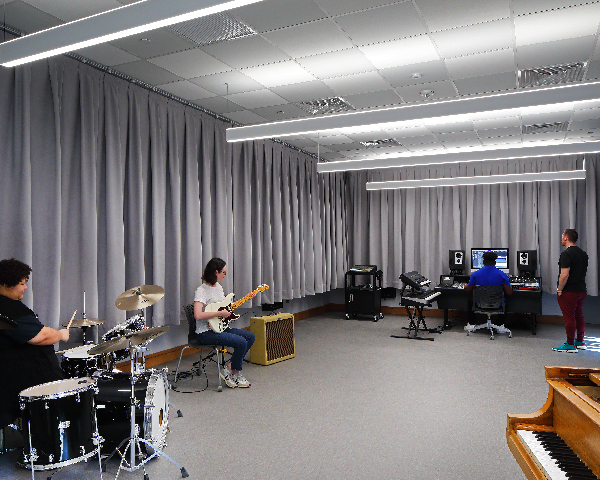
In the live room, we enhanced flexibility for playing and recording different music and adjusting acoustic ambiance. Adjustable curtains and curved reflectors absorb / diffuse sound, providing acoustical flexibility for playing and recording. Ceiling tiles alternate between reflective and passive to help tune the room; insulation above absorbs undesirable frequencies. Angled interior windows minimize sound reflection and help isolate the room from street noise.
The control room is designed to be as quiet as possible for sensitive recording setup and editing. There’s a large bass trap concealed at the north end of the room, all the walls are fabric-wrapped insulation, and there are more non-reflective ceiling tiles with insulation to absorb sound.
Between the live and control rooms is an acoustically isolated window for observation. Both rooms are wired for analog and digital recording with provisions for microphones, digital and analog inputs, and headphone monitoring. Recordings can be monitored, edited, and played back from either space using mixing boards.
Given the specialty products involved, the renovated rooms look and function great. At the end of the renovation, the project acoustician tested the overall performance and isolation of the renovated spaces and found they exceeded performance goals!
November 17th, 2021

The Philadelphia College of Osteopathic Medicine (PCOM) teaches graduate students holistic approaches to medicine — utilizing a whole person approach, “treating people, not just symptoms.” Lacking on-campus housing since the school moved to its present location on Philadelphia’s City Line Avenue in 1957, PCOM existed as a commuter school with limited campus life accommodations.
The school understood a longstanding need for student housing on campus. Busy medical students have limited time and must focus on studies: living on campus allows more concentrated academic time while promoting collaborative learning. And PCOM’s peer schools can provide housing that enriches campus life. So when Overmont House — a 1971 apartment building for elderly residents at the edge of PCOM’s campus — became available, the College purchased the building to convert it into the campus’s first residential hall.
VSBA was retained to design this transformation. The structure is a 12-story tower with a masonry envelope and repetitive interior layout. Built with a modest budget, it was highly efficient but spartan in its allocation of space, quality of construction, and finishes. The building hadn’t been well maintained, the exterior envelope needed repair, building systems needed replacement, and small apartments were cramped with low floor to ceiling heights. How could VSBA — working with these constraints and a tight budget — transform the building into a modern, gracious campus facility?
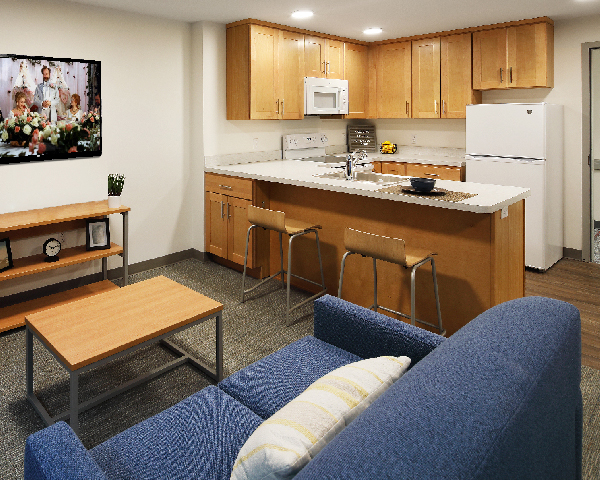
We started by rethinking the residential units. We reimagined them as studio and one-bedroom apartments with different configurations. We opened up their layouts to create more airy, light-filled spaces. The new fully-furnished units included contemporary kitchens, plenty of storage space, and many modern amenities.
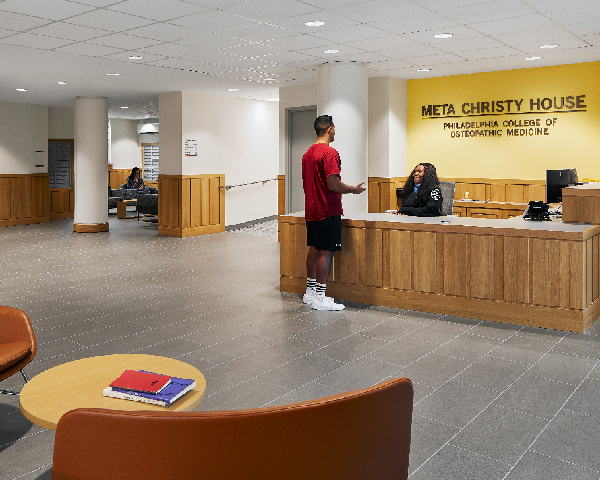
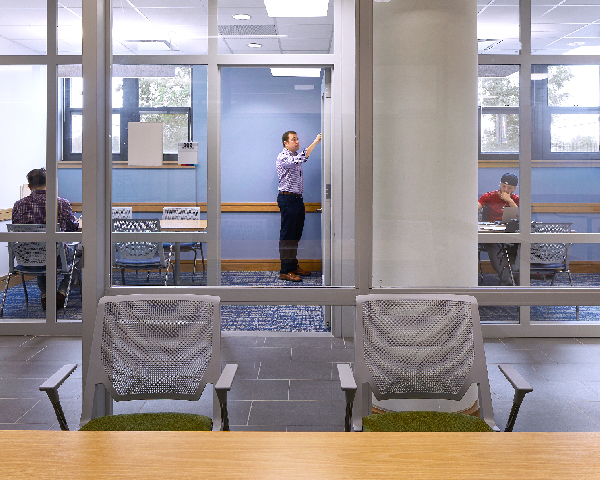
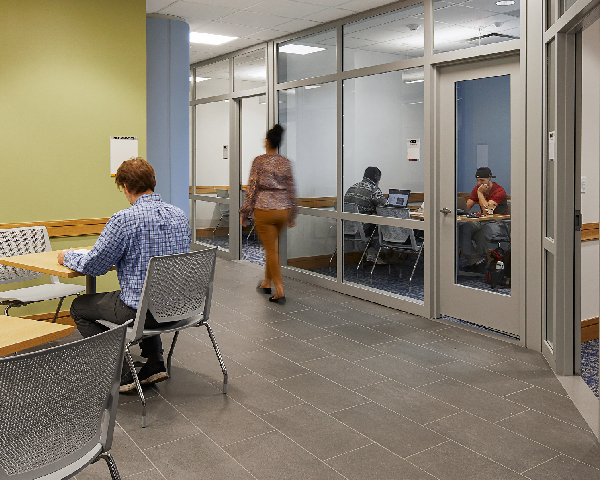
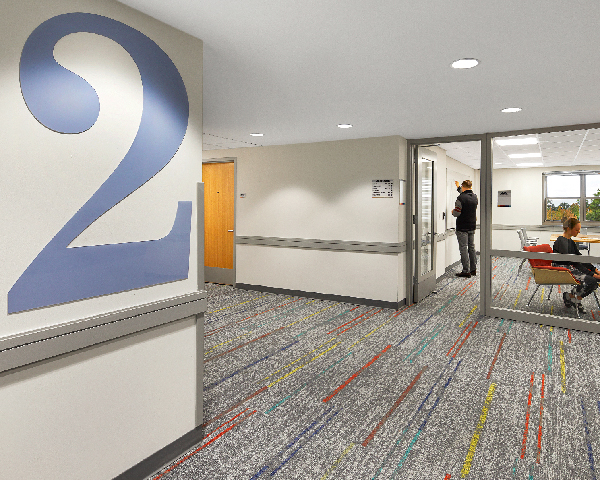
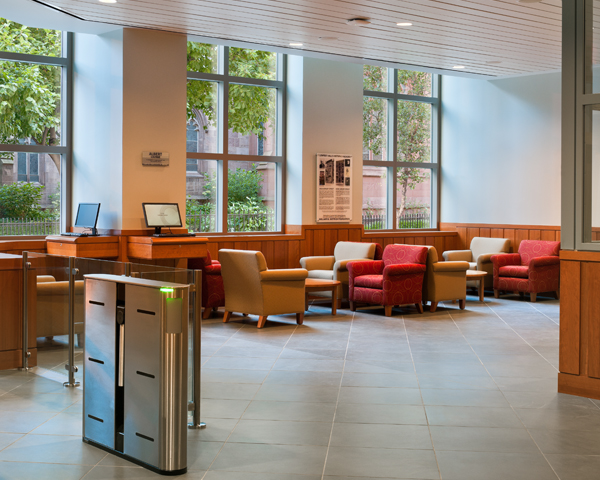
Beyond the units, every floor includes laundry facilities and shared study spaces. The building’s lower level and first floor offer a commons with student lounges, mail room, package retrieval system, and individual and group study rooms (some with integrated audiovisual tech).
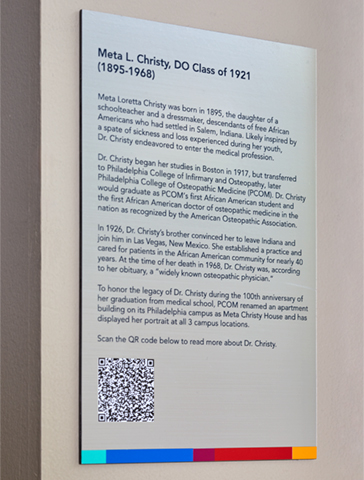
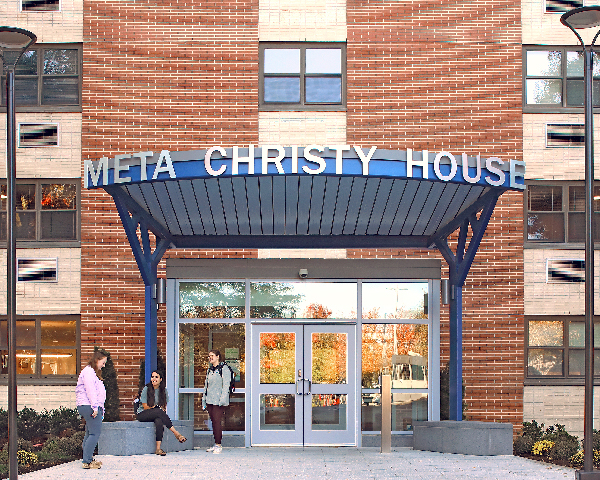
We renovated the building’s exterior masonry, replacing flashings and damaged masonry at relieving angles, and replaced the roofing (adding insulation). A new free-standing entry canopy serves as a portico for the renewed building and link to the rest of campus. The canopy announces the building’s title — Meta Christy House — named for Meta L. Christy, DO, PCOM Class of 1921, the first African American osteopathic physician in the nation.
October 8th, 2021

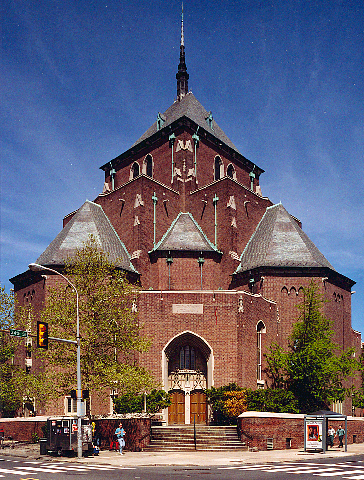
The Perelman Quadrangle expands the original functions of Houston Hall across Penn Commons into parts of the surrounding Irvine Auditorium and College, Claudia Cohen, and Williams Halls. In the process each is preserved and adapted and helped to reestablish the importance it once held, on an augmented and replenished Quadrangle. The central space, Penn Commons, lined by Collegiate Gothic and High Victorian buildings, set with shade trees and enriched with seating, rostrums and heraldry, will once again form a memorable image of the University of Pennsylvania.
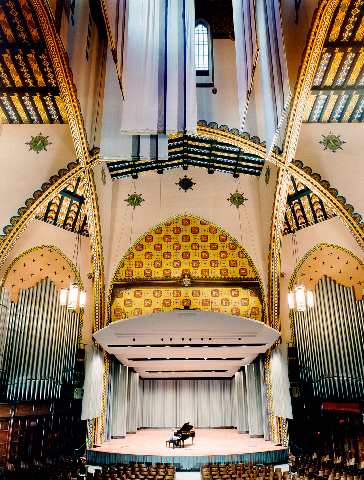
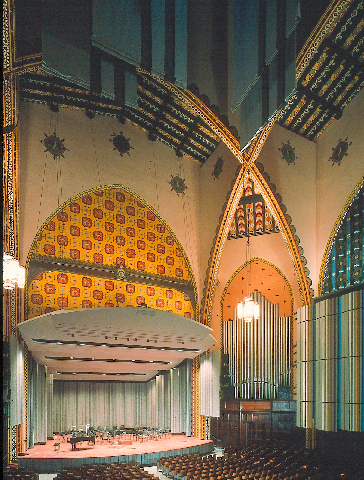
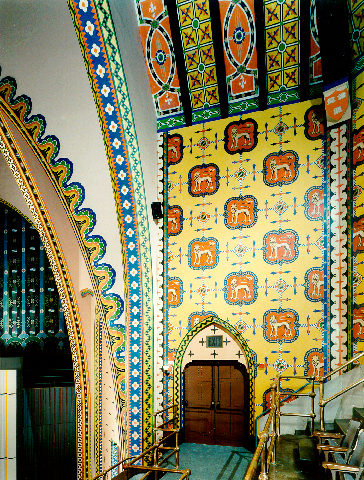
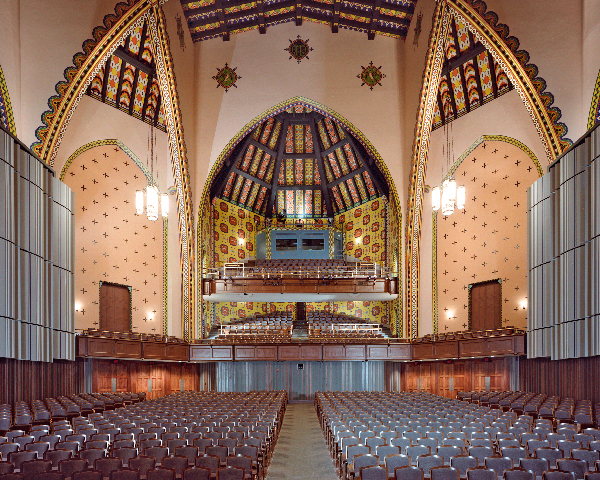
Irvine Auditorium was designed by Horace Trumbauer in 1929. Irvine is distinguished by its bold, brightly, colorful stencils covering nearly all wall surfaces, and its 30,000-pipe Curtis Organ (designed for the Philadelphia Sesquicentennial).
We adaptively restored the great hall of Irvine Auditorium as a multi-use performance hall with a 1200-seat capacity. Our renovations provide the auditorium with modern sight-lines and acoustical, lighting, and environmental conditions for music, speech, and organ performances, while we preserved its chromatic architectural glory and its historic organ.
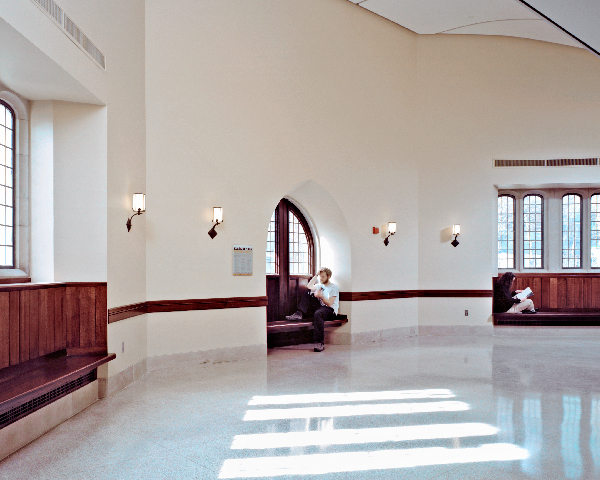
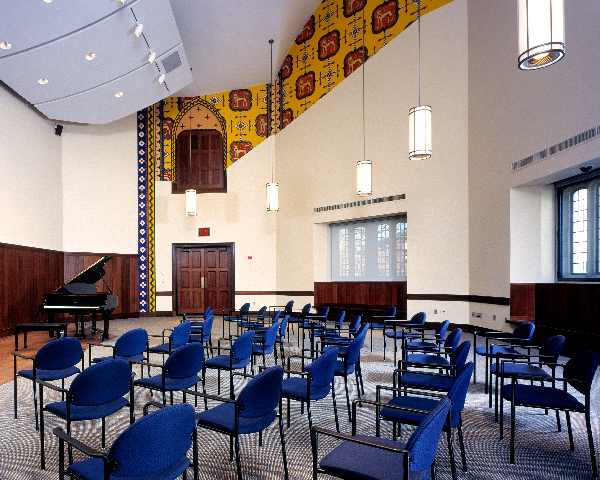
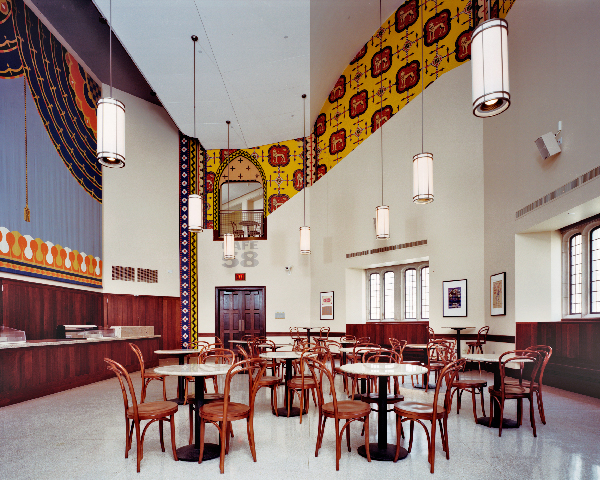
Due to its great interior height, which produced long reverberation times, and its square shape, the auditorium was never an acoustic success. Because of this problem, it received very little use over the years, and was allowed to deteriorate. Working with acoustician George Izenour Associates, we improved acoustics by removing two side balconies and thereby reconfiguring Irvine into a classic shoebox shape, with acoustic baffles at the sides to reflect sound back to the audience. Removing the balconies also produced two adjacent two-story spaces — one which became a cafe, the other a 125-seat recital hall. A permanent acoustic shell was added to the expanded stage, projecting sound out to the audience. Moveable absorptive banners were added in the 120′ high tower, in order to control the reverberation times.
The decorative stencil pattern at the auditorium interior was completely restored to its original brilliance by Conrad Schmidt Studios, with the technical assistance of Noble Preservation.
Student practice rooms, meeting rooms, a rehearsal hall, expanded lobby spaces, and appropriate backstage spaces are also part of the restoration scheme. A new campus-side entry from the Commons to Irvine will facilitate day-to-day use and enhance Irvine’s participation in the Quadrangle.
October 26th, 2017

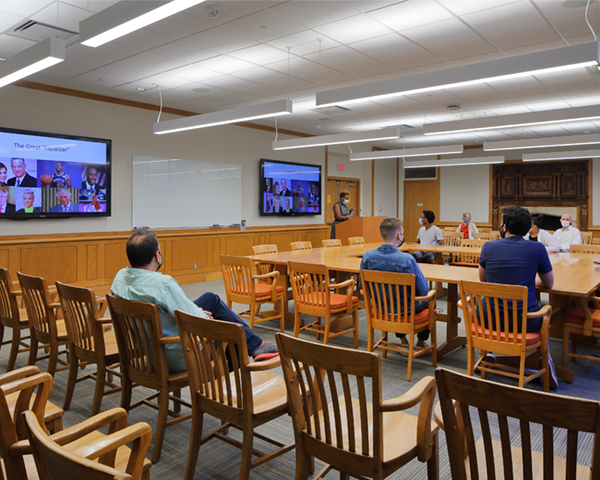
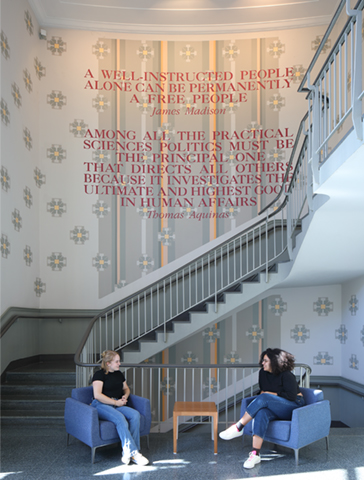
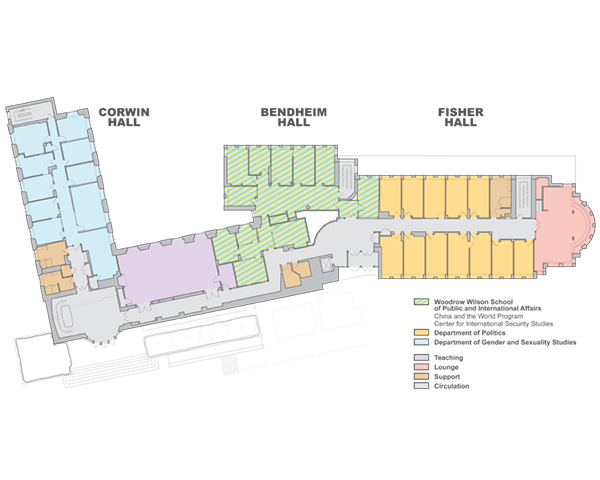
VSBA was recently hired to design extensive renovations to Princeton’s interconnected Fisher, Bendheim, and Corwin Halls, which will provide space for the Woodrow Wilson School of Public and International Affairs as well as politics, gender and sexuality studies, and computer sciences.
Our work — including programming, design, furnishings, signage, and window replacement — is helping to preserve the building’s history while accommodating new users and updated amenities.
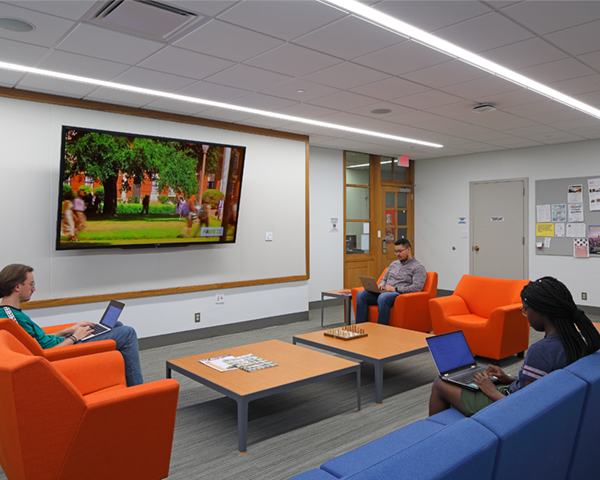
The scope encompasses office, meeting, teaching, study, and social spaces for several academic departments and study centers that will be moving into the renovated spaces. Our designs take a fresh look at how faculty work and teach and how students learn and study, in the context of changing technologies and teaching methods.
Venturi, Scott Brown and Associates designed Princeton’s Fisher and Bendheim Halls in 1990. Our renovations respect and celebrate core elements of the original designs, while sensitively introducing new programs and activities.
April 19th, 2017

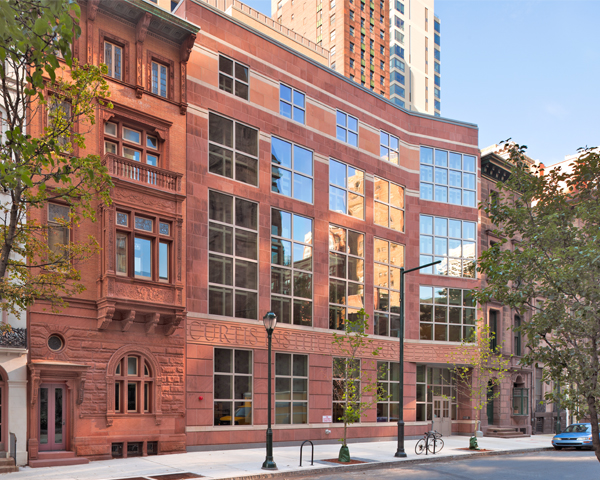
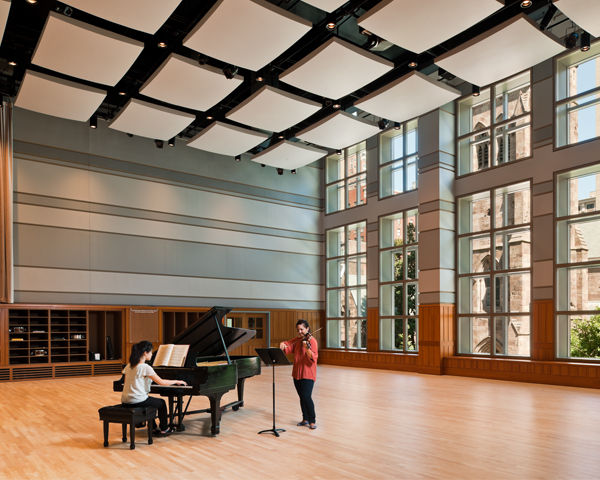
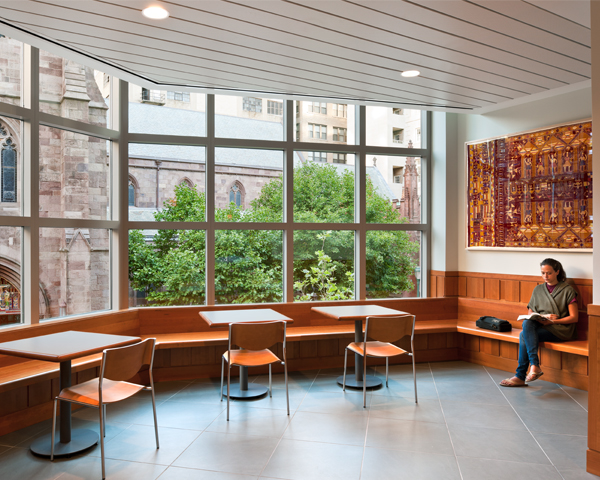
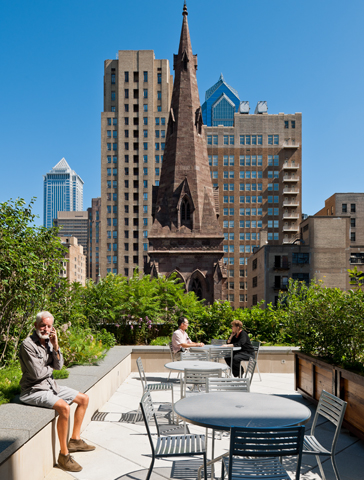
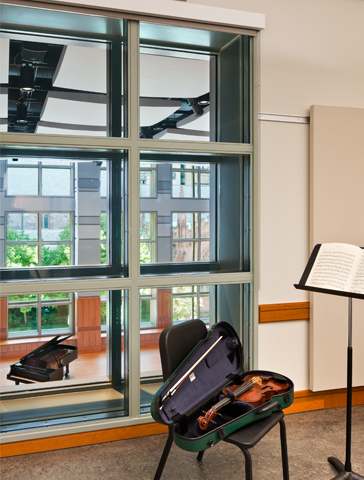
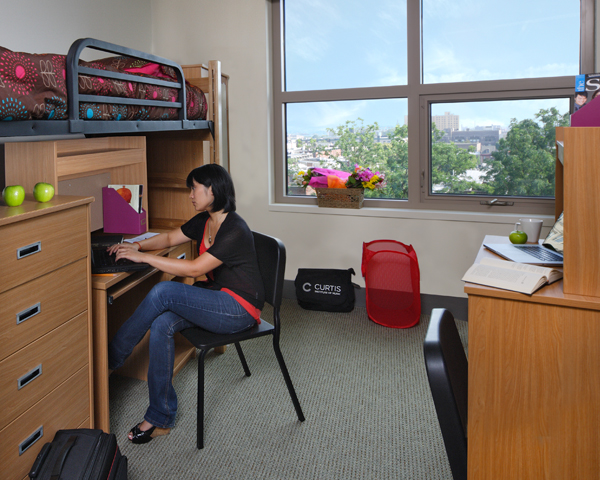
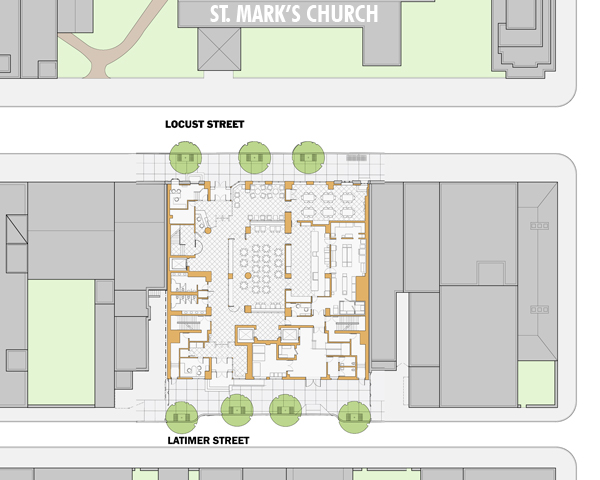
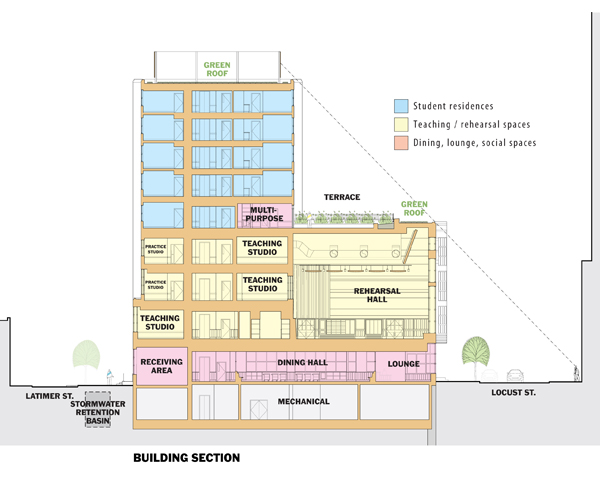
VSBA designed this major new multi-use music education and student residence building for the renowned Curtis Institute of Music. The expansion — on a historic block of Philadelphia’s Locust Street — provides state-of-the-art facilities for practice and teaching, an orchestral rehearsal room, and student residences, all in close proximity to existing facilities on Rittenhouse Square. Amenities include dining and social spaces and an outdoor terrace shared by students, faculty, and staff. The project has achieved LEED Gold certification.
The building incorporates box-in-box construction to provide appropriate acoustical isolation of all music spaces. The rehearsal hall is designed for flexible use with adjustable acoustics and is equipped with separate audio and visual recording studios. All teaching spaces and studios have recording/playback systems. Structural and mechanical systems were carefully designed to meet demanding acoustical requirements.
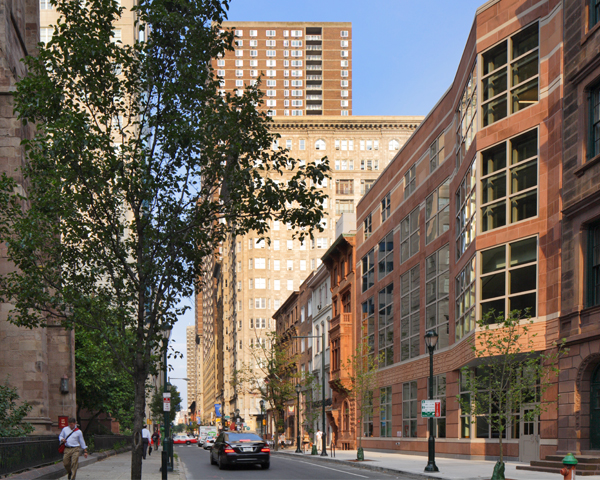
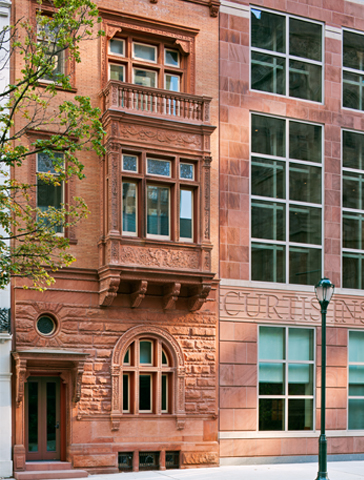
Our design responds to the scale and character of the historic streetscape. A four-story façade on Locust Street is clad in brown sandstone with window groupings and horizontal accents that relate to the rhythm of neighboring townhouses. To either side we preserved and restored existing historic façades, incorporating them into the design to help preserve the character of the street. Yet our work concurrently promotes the new, 21st century identity of the expanded institution: a carved frieze across the façade identifies the building with a bit of civic flair, a projected bay window highlights the entry, and generous windows express the 30′ high rehearsal hall.
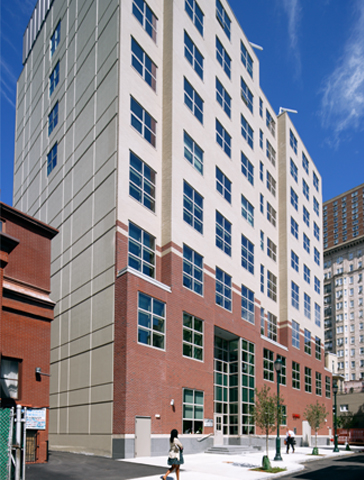
We worked closely with near neighbors, community groups, and other stakeholders to build consensus for the design and secure approval from the Philadelphia Historical Commission. Of particular note, student residences are located in a tower set far back from Locust Street and clad in a beige-gray brick; this renders it minimally visible from Locust Street and apparently a separate building. We created a series of sun-shadow studies to visualize the impact of the tower’s shadow throughout the year to ensure minimal shading of historic St. Mark’s Church across the street. On the building’s other side, a setback the use of red brick continues the scale of Latimer Street’s buildings while beige brick above reflects sunlight into the narrow street.
Photos by Tom Crane and Matt Wargo
April 19th, 2017

As a component of our work at Lehigh Valley Hospital – Cedar Crest, VSBA planned, designed, and oversaw construction for the Center for Advanced Health Care, a LEED Silver certified facility whose mission is to create a personal, patient-centered and life-affirming experience for the patient. The 4-story, 132,000 square foot medical office building provides a range of ambulatory care services at the east side of campus.
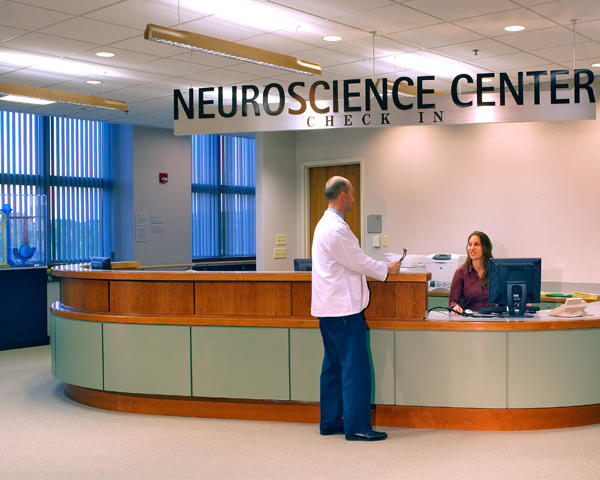
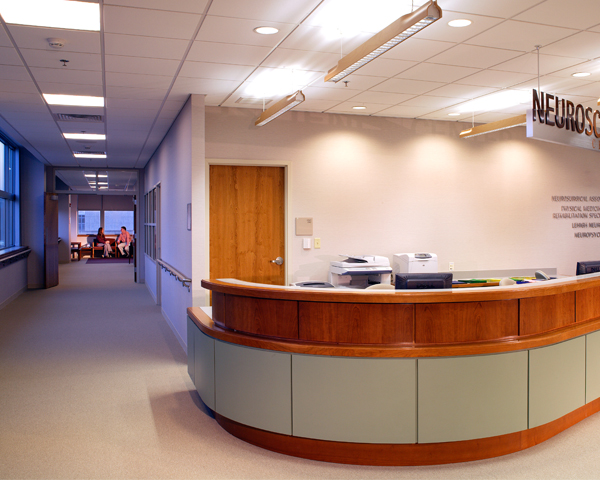
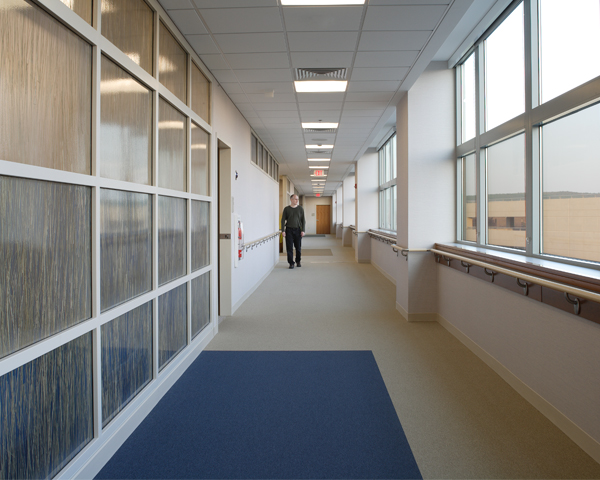
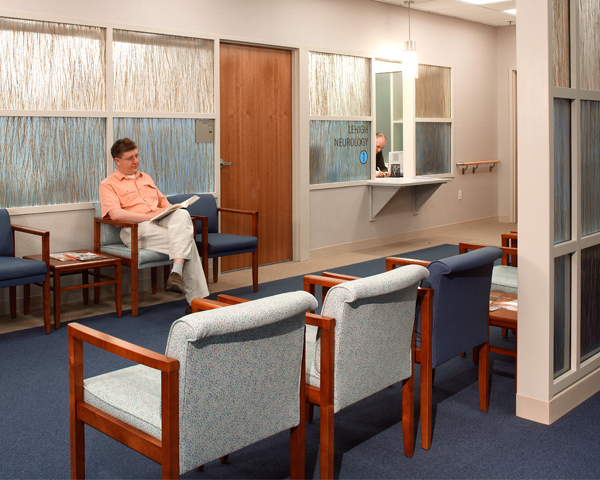
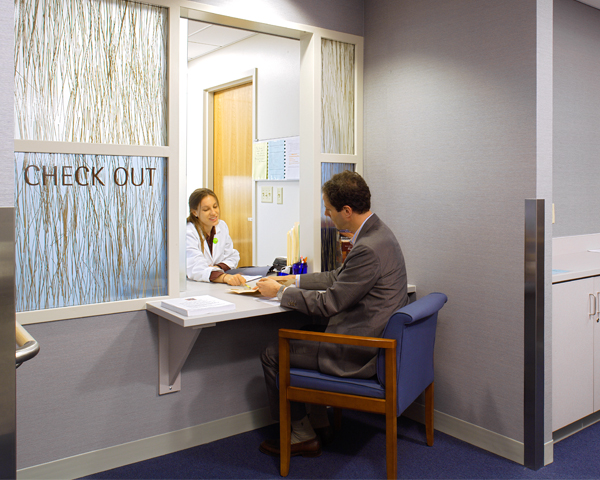
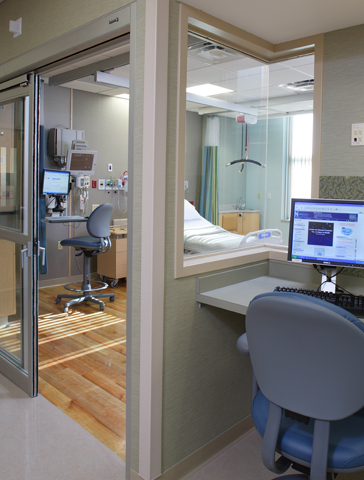
VSBA planned and designed the interior of the building’s lobby and two floors. The fourth floor outpatient Neuroscience Center serves patients and encourages cross-disciplinary collaborations by staff, physicians, and all care providers. The Center’s mission is to create a personal, patient-centered and life-affirming experience for the patient. The 30,000 sf facility brings together neurology, neurosurgery, neuroradiology, neuropsychiatry, physical and occupational therapy, and a range of Centers of Excellence in one comprehensive center.
The Neuroscience Center program derives from extensive planning by workgroups and architects, comprised of practice and hospital representatives, whose goal is to create a collaborative environment that benefits patient care and encourages innovation and interdisciplinary interactions by care providers.
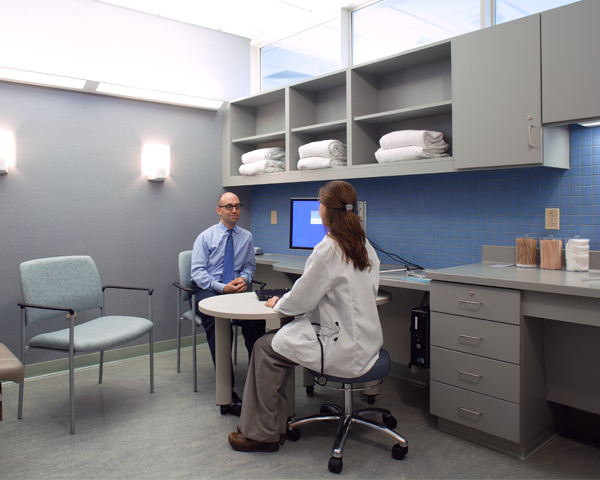
The Center’s floor plan is organized into a series of flexible pods of examination and consultation rooms, with associated clinical and administrative support areas to allow multidisciplinary care teams to come to patients — rather than have patients move from specialist to specialist, as part of one comprehensive visit. Wayfinding and circulation paths are simple and easy to travel for patients with a range of mobility and cognitive challenges. Patient encounter spaces can be used in a variety of ways, allowing for unknown evolutions in clinical practice. Technology will have an increasing role in the organization, work flow, and patient interactions on the floor, and the backbone for this is provided in the architecture and systems design.
Finishes and materials for the clinical areas were selected to balance an image of efficiency with warm, natural, and soothing elements that appeal to patients and their families. Administrative areas are also designed with careful attention to natural light, views, and appealing finishes.
April 19th, 2017

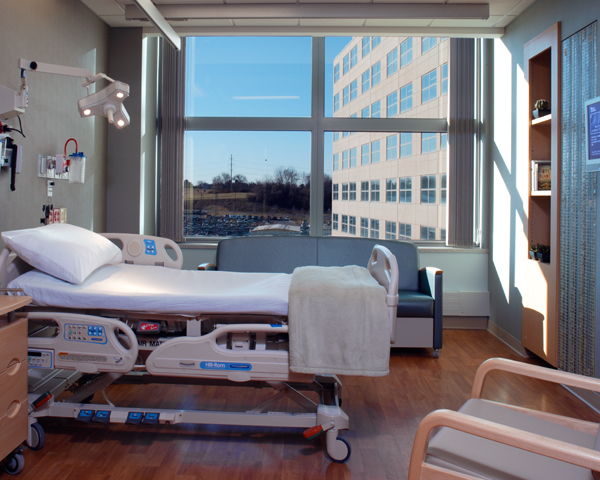
VSBA designed a major expansion for the Lehigh Valley Hospital’s Cedar Crest Campus and oversaw construction of the final phase of its facility master plan projects. The Kasych Pavilion, centerpiece of the campus, includes:
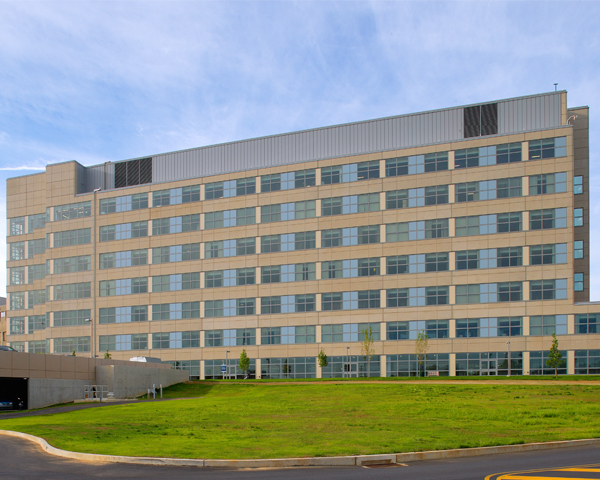
The Pavilion’s design derives from the context of existing hospital buildings and their precast concrete and aluminum curtain wall aesthetic. The new building defers to the existing central entrance but creates facades that are predominantly windows into patient rooms and colorful aluminum panels. At ground level, large expanses of windows encourage transparency and connections between the interior concourse and the exterior “Avenue of the Arts.” The modularity of the building’s function inspires the rhythmic patterns of vertical and horizontal materials and details.
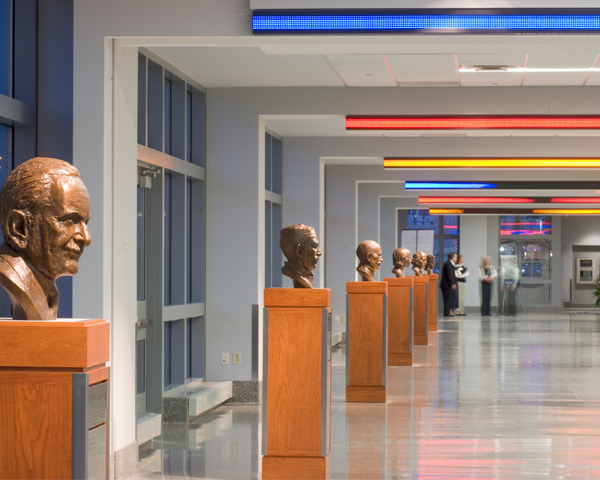
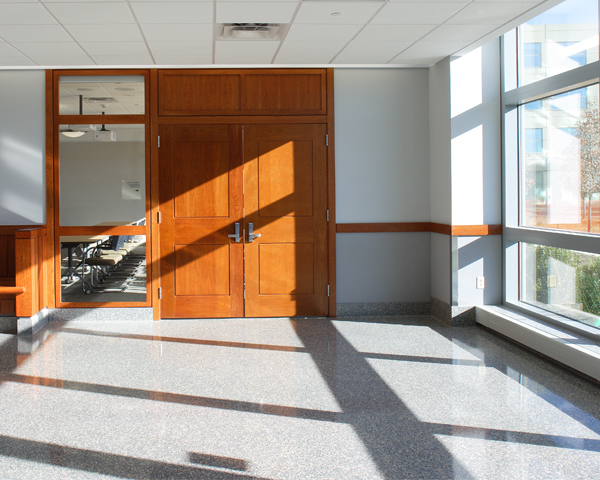
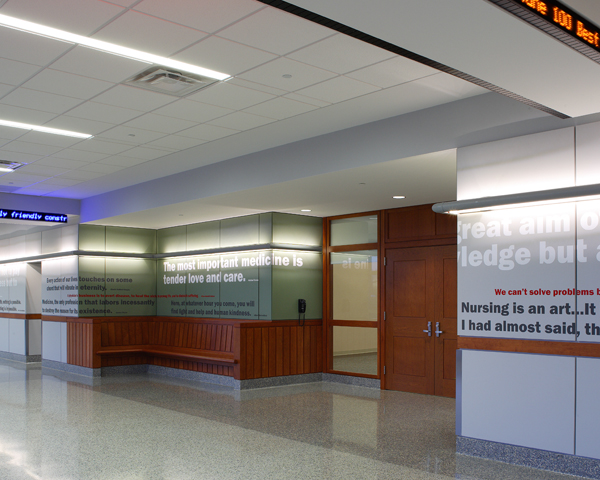
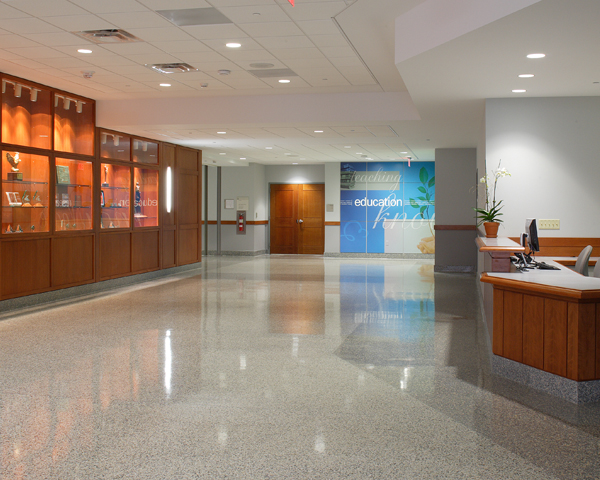
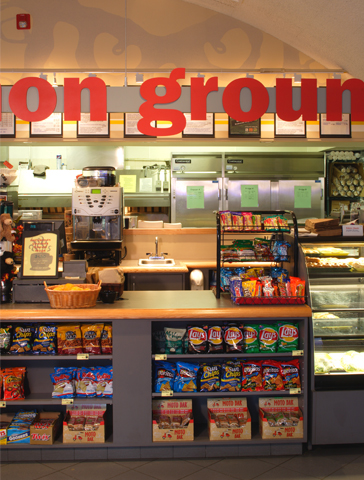
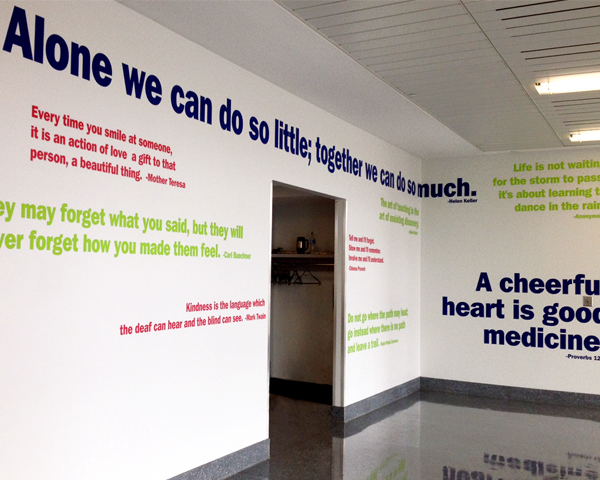
The interior concourse connects the new building to the existing pedestrian circulation system, bringing it to the front to allow natural light and exterior views. This space is designed to be a place for patients, visitors, conference attendees, and staff, so it must accommodate their varied needs. A convenience store, located near the staff entrance, provides a needed amenity for nurses and physicians on their way to and from work. The concourse is furnished with durable terrazzo floors, laminate wall panels, and natural cherry wood doors, benches, and display cases. Graphics and fine art adorns the concourse, including quotes from inspirational thinkers and bronze casts of medical educators. Graphic panels and a comprehensive signage program throughout the building describe the sustainable initiatives used to achieve LEED certification.
The Kasych Pavilion is an environmentally friendly building. One of the fundamental principles of healing and healthcare is first do no harm, and in our design we’ve minimized impact on the global environment while taking many measures to make sure this building is healthy and safe. Specific strategies include:
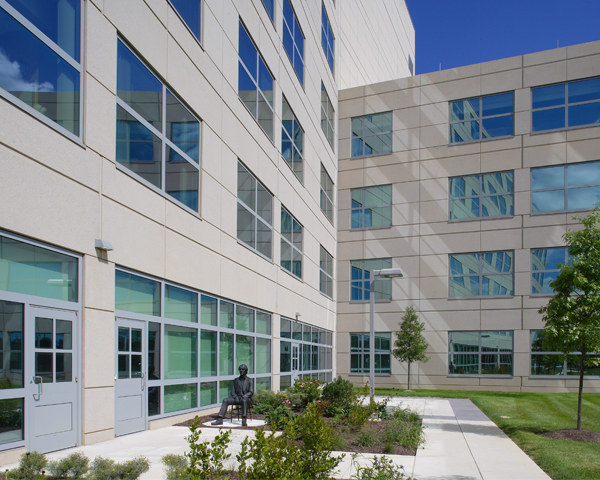
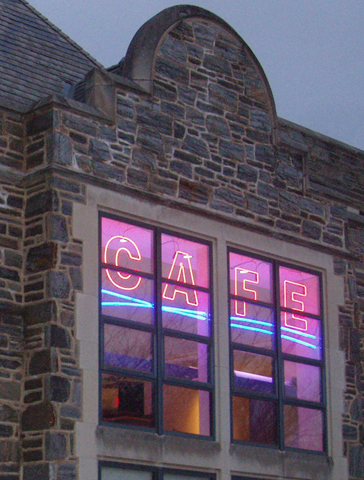
As a component of our work at Lehigh Valley Hospital’s Cedar Crest campus, VSBA planned, designed, and oversaw construction for the Center for Advanced Health Care, a LEED Silver certified anchor for ambulatory care whose mission is to create a personal, patient-centered and life-affirming experience for the patient. Physicians’ offices, clinical spaces, and other tenants are located here. VSBA was Design Architect for the site planning, massing, exterior skin, and public spaces of the building, as well as two floors of clinical facilities within the building, the Neuroscience Center, and the Lehigh Valley Heart Specialists Diagnostic Center. The floor also contains a public corridor connecting the enclosed pedestrian bridge to the building, and a café serving light food and drinks for building occupants, patients, and families.
April 19th, 2017

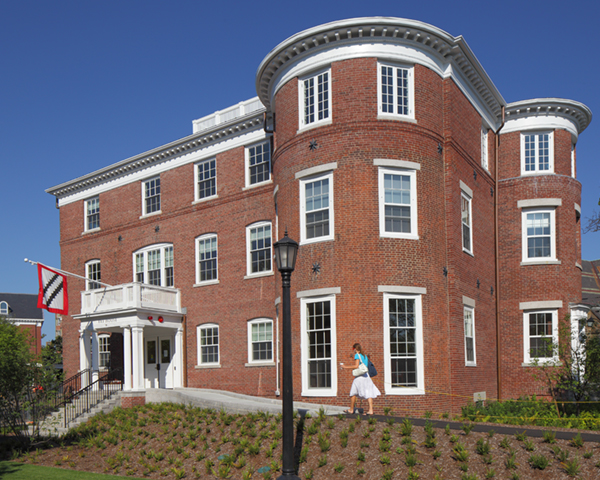
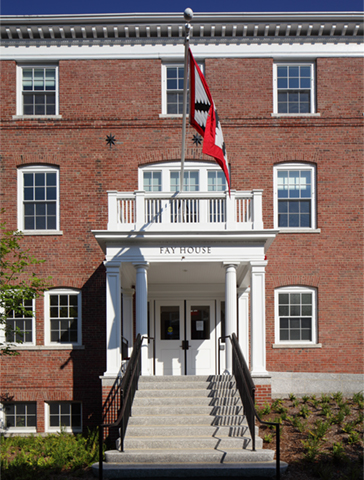
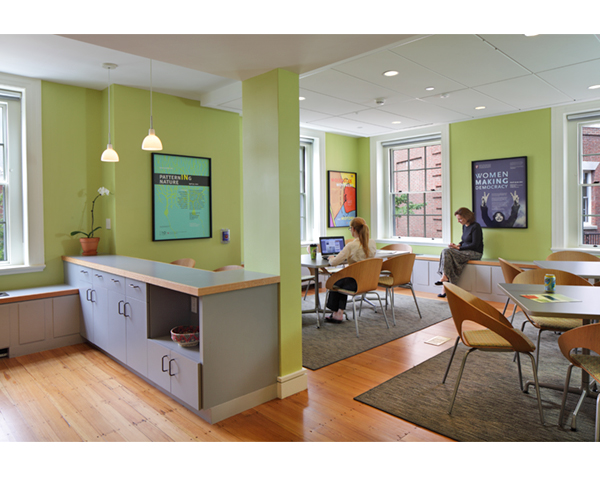
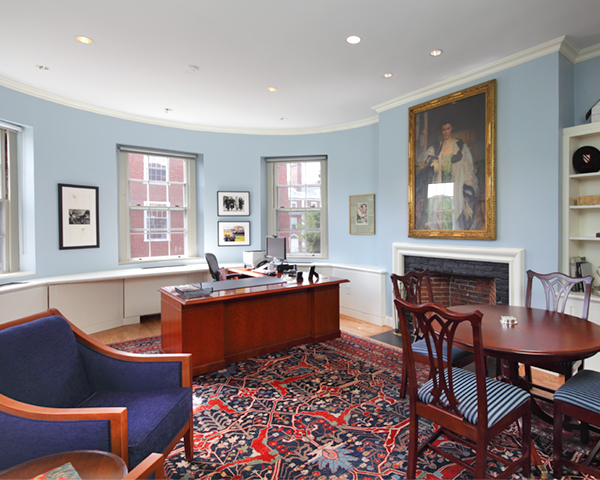
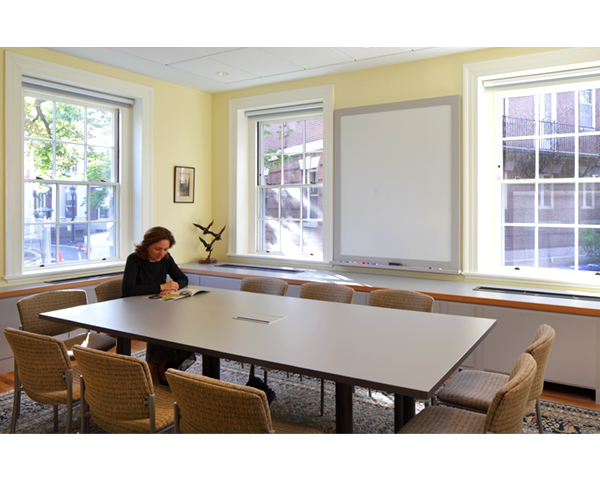
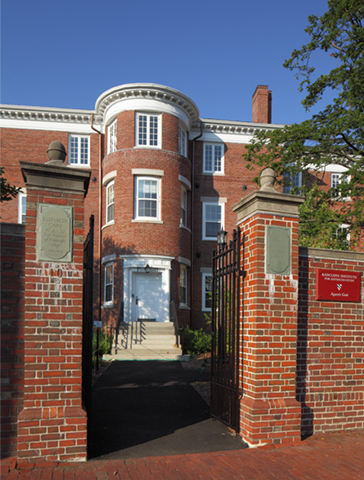
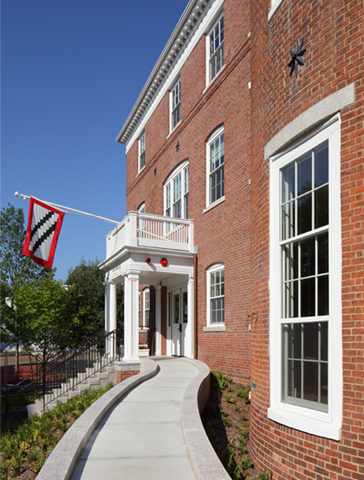
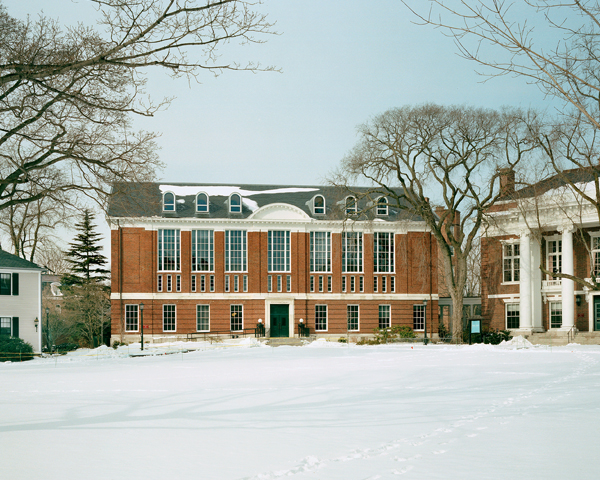
Fay House is the original home of Radcliffe College and now the administrative building for the Radcliffe Institute for Advanced Study. It was built in 1807 and expanded both horizontally and vertically over the years.
Following an initial programming study and scoping analysis, VSBA embarked on a renovation to preserve the most important historic features and character of the building while:
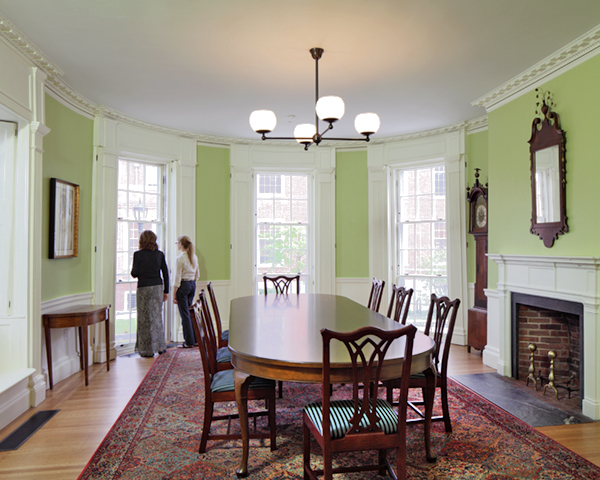
The Colonial/Federal Revival Sheerr Room was Radcliffe’s first auditorium. A major goal of our renovation was to preserve its character while meeting the new audio/visual requirements. This multi-use, reconfigurable space now features a large screen and projection system, video teleconferencing system, overhead speakers, and amplifier.
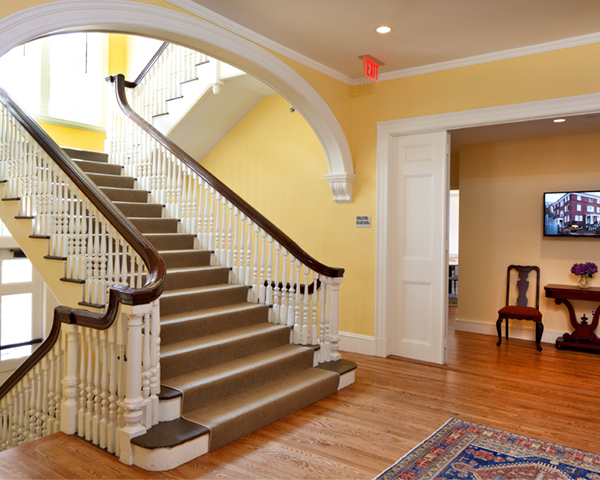
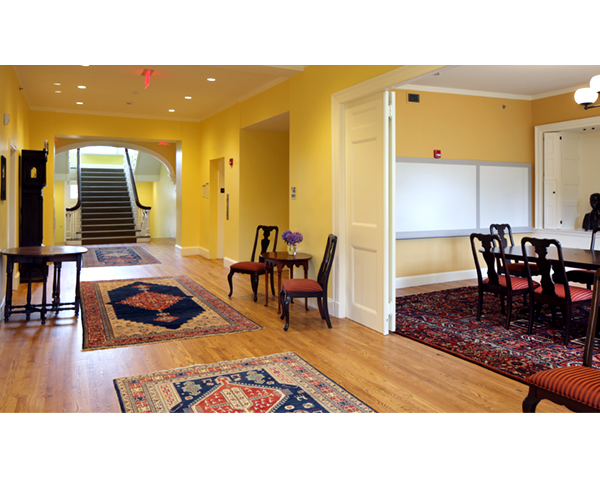
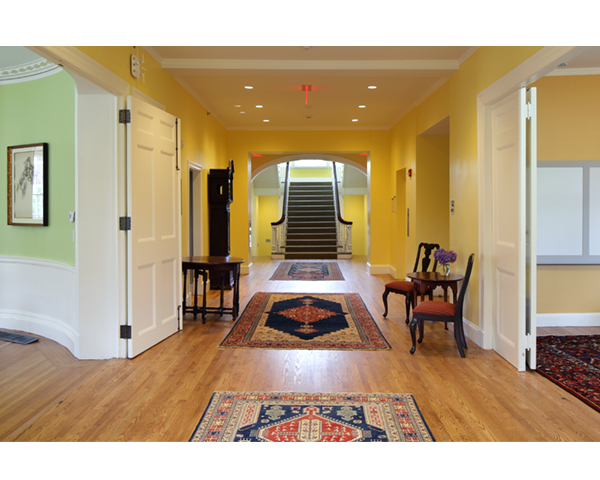
Fay House is LEED Gold certified; as of its completion, it’s the oldest LEED certified building in the United States. Fay House powers down appliances as well as lights when the building is not in use, reducing power use and waste. Occupancy and daylight sensors, as well personal lighting controls, allow adjustment of light per room and usage. Also, renovations introduced daylight and views to working and meeting areas.
April 19th, 2017

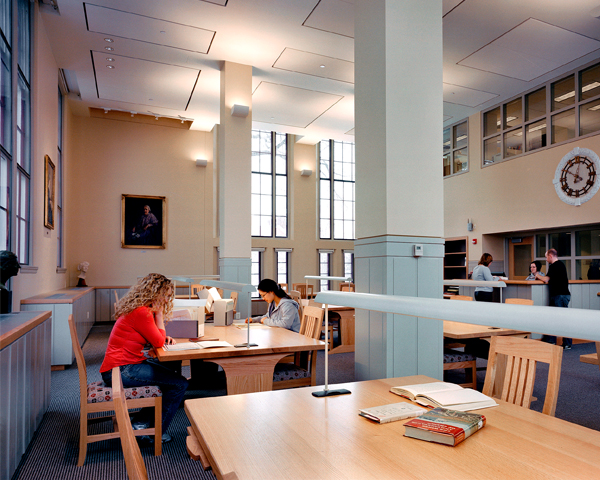
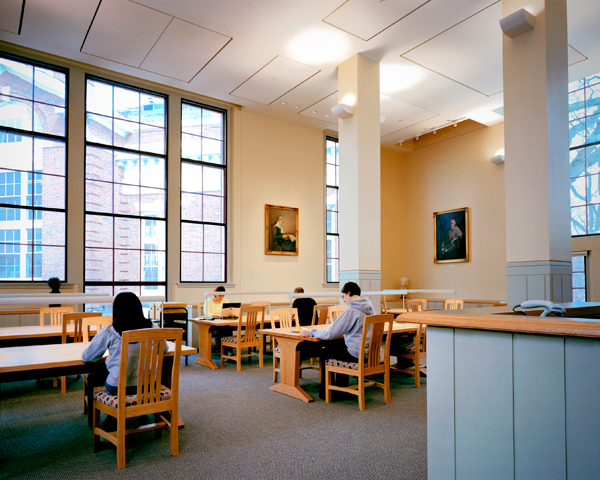
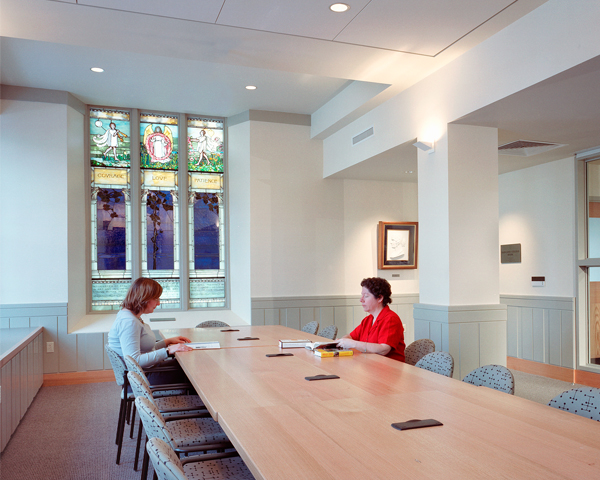
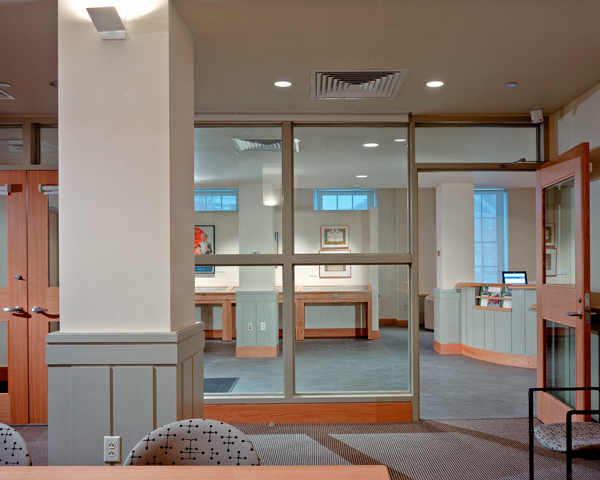
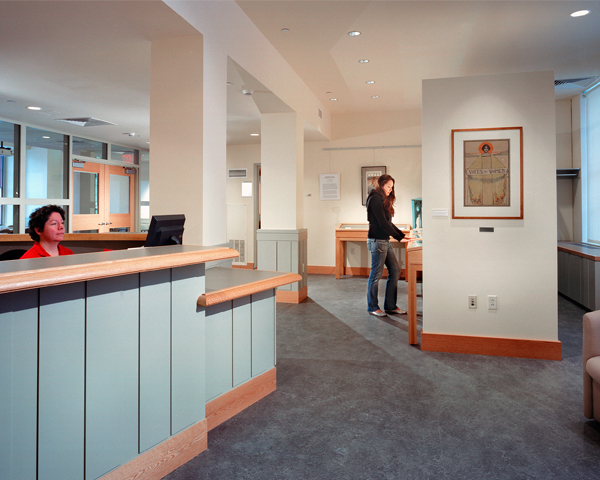
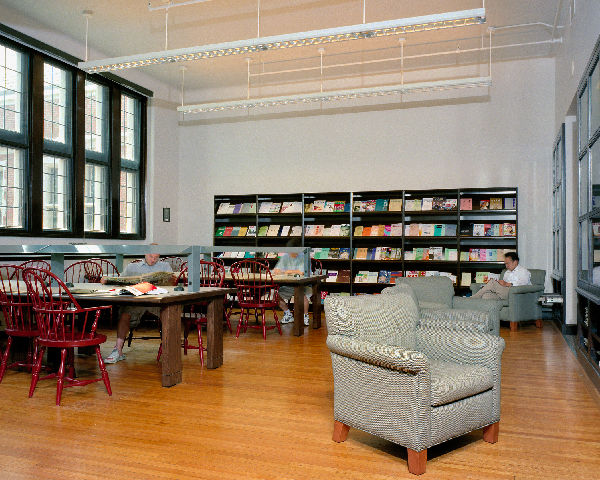
VSBA programmed and designed a renovation of the Arthur and Elizabeth Schlesinger Library for the History of Women in America, one of a group of buildings at the head of historic Radcliffe Yard. Built in 1907 and originally home to the Radcliffe College Library, the building became a research library in 1967. It’s now an important component of the Radcliffe Institute for Advanced Study.
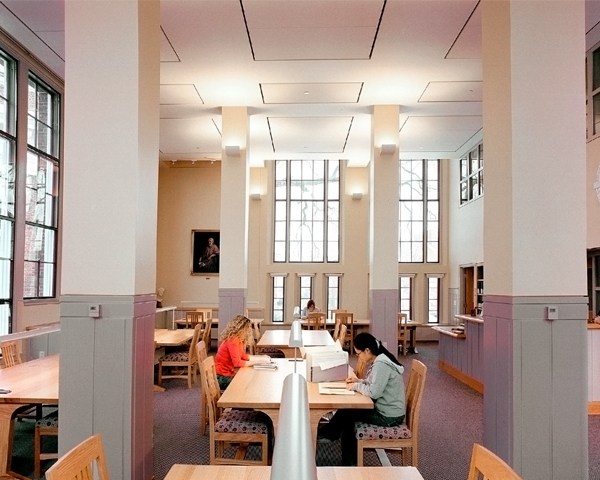
Over time, the building became more intensely and densely used to meet the needs of a modern special collections library. In the process, most of the character, grace, and generosity of the original building interior was obliterated. Our challenge was to help the Library recover some of its character while meeting the 21st century needs of an important collection and contemporary caretakers and users. We:
This project was the first increment of the Radcliffe Institute’s campus plan, completed by VSBA in 2002. Our renovation supports the goals of the overall plan, with exhibition and meeting space on the first floor and a newly accessible entrance from Radcliffe Yard. An area of the second floor was returned to double-height reading room space, and existing original building elements — such as the ornamental stair and the Sarah Wyman Whitman Room — were refurbished and maintained in public view.
The renovated Schlesinger Library has been LEED Certified for its efficiency, environmental sensitivity, and sustainable approach to interior environments.
April 19th, 2017

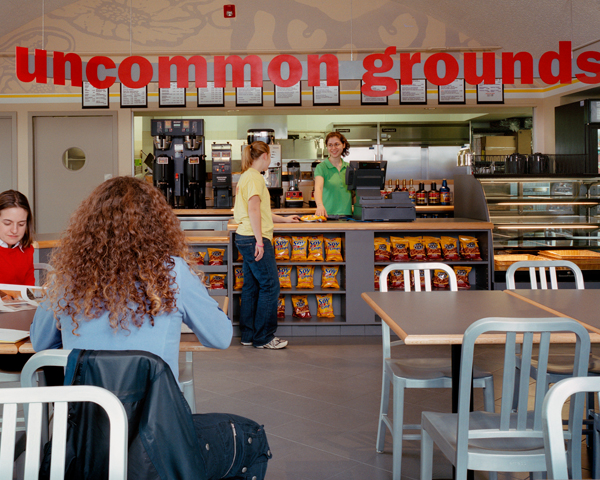
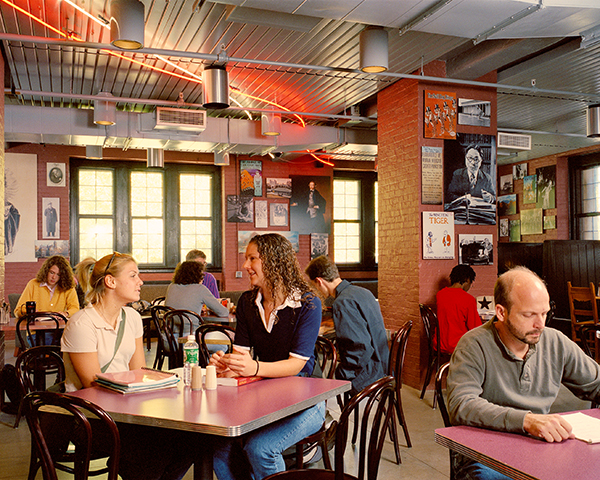
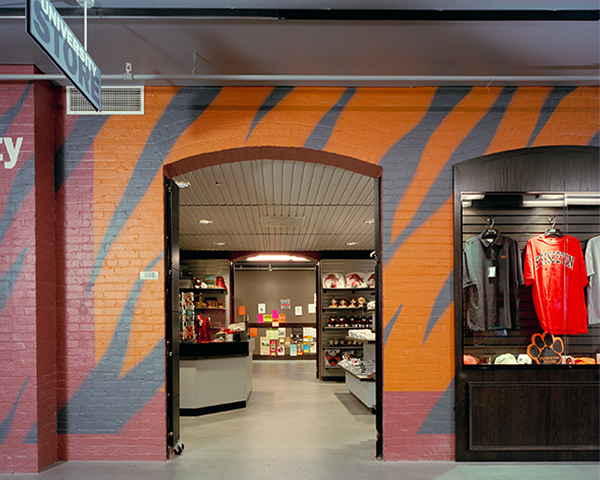
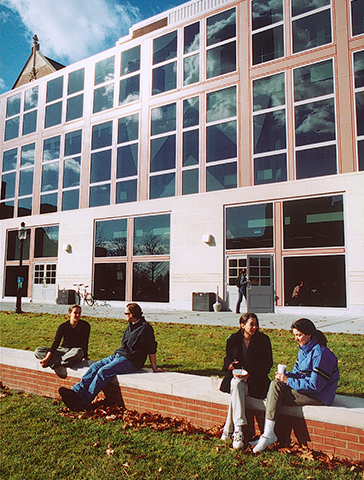
VSBA was asked to suggest ways of improving and enlivening the student-centered spaces on the first level of Bryn Mawr College’s Campus Center. The College wished to make the spaces more student and visitor-friendly and more emblematic of Bryn Mawr spirit. VSBA redesigned the Café and Main Lounge, converted an adjacent meeting room to a student rec room, and created more visible connections between spaces. Throughout, traditional symbols of Bryn Mawr’s past and present express the College’s identity and spirit. The Main Lounge and Balcony include:
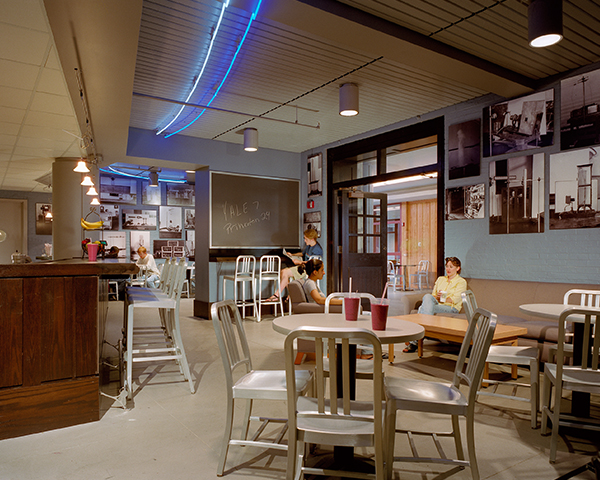
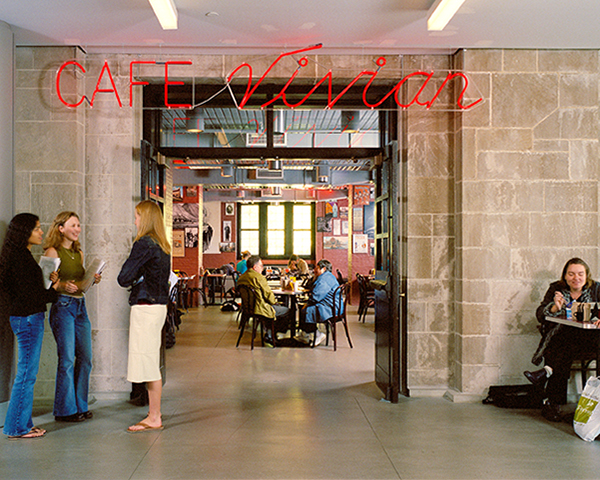
In the reorganized Café, new menu boards and café identity signs are set against a backdrop of College symbols and memorabilia:
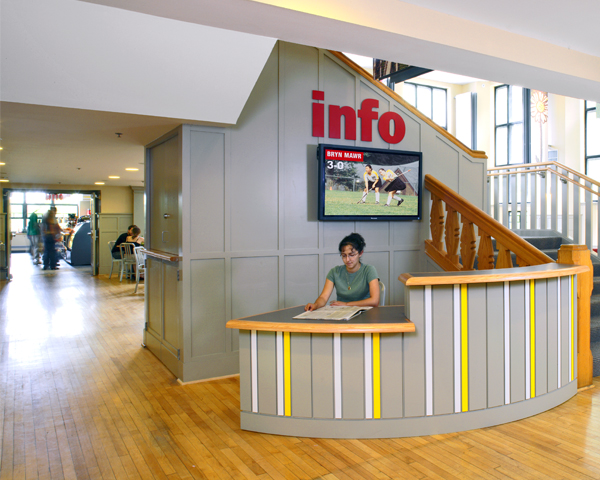
The campus “rec room” — formerly a meeting room — will be hung with rotating exhibits of student-created, student-selected artwork. Main circulation spaces include large bulletin boards for student postings and e-mail stations. A new information desk and informational plasma screen were also installed.
April 19th, 2017

When we designed a new hospital building for the Lehigh Valley Health Network at Muhlenberg, we incorporated a series of large decorative murals in the lobby and public circulation areas.
Subsequently, we were asked to adapt these large-scale murals for two other locations — elsewhere at the Muhlenberg hospital and also for their Mack Boulevard administrative building.
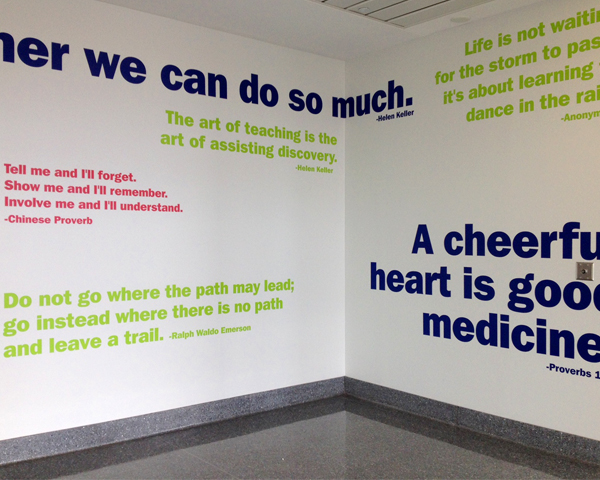
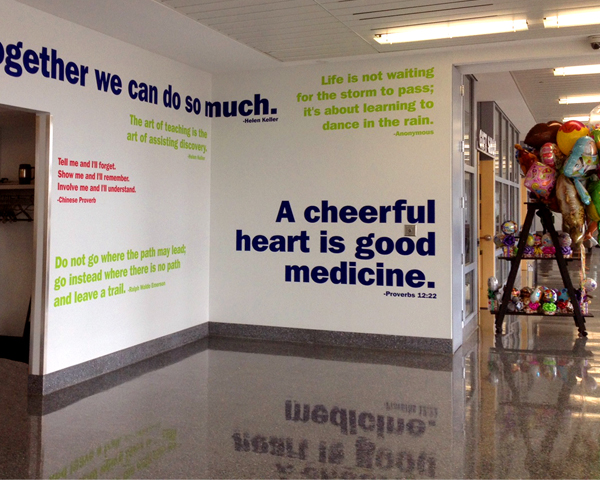
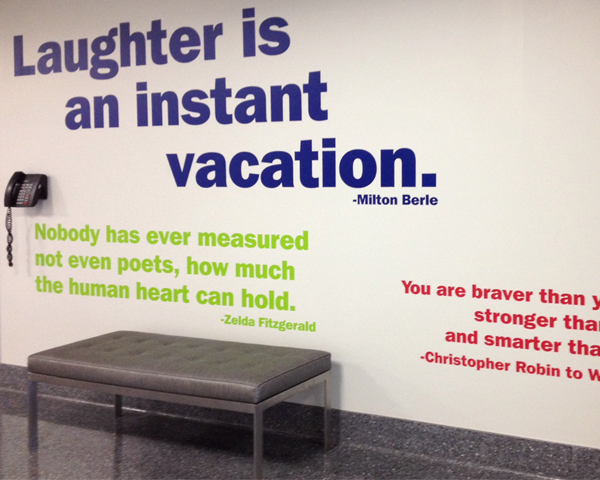
Our murals are composed of a selection of quotes from many sources, which were selected by LVHN employees. They’re intended as comforting, supporting, inspirational, and humorous. We used vinyl lettering, which is durable but also economical and easily removable.
April 19th, 2017

VSBA renovated and expanded Palmer Hall, Princeton University’s original physics laboratory, to house the new Frist Campus Center. The University first proposed a campus center in the 1920s, but the project wasn’t undertaken until the 1990s. Palmer Hall, historically significant though deteriorated and underutilized at the periphery of the traditional campus core, over time became the geographical center of the changing campus. Paths linking academic, social, recreational, and residential activities intersected at the site.
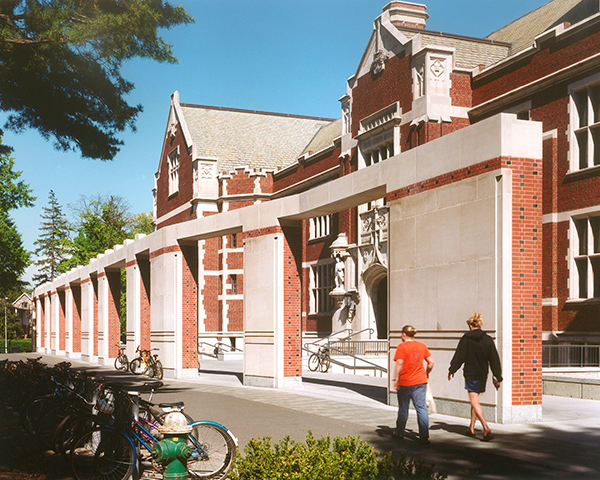
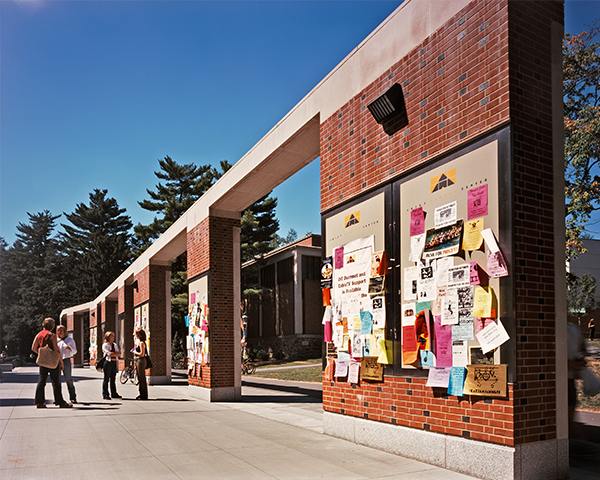
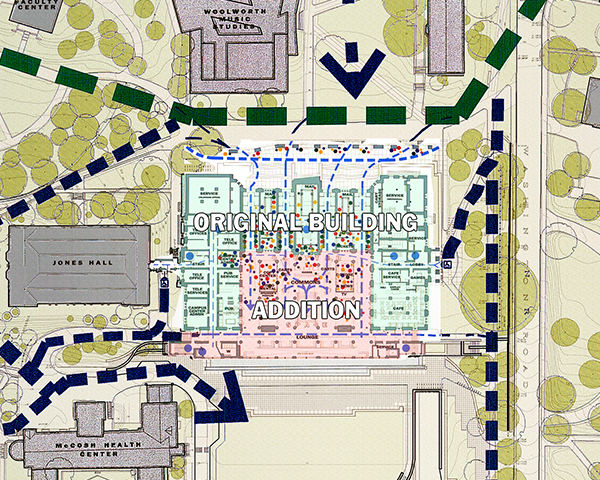
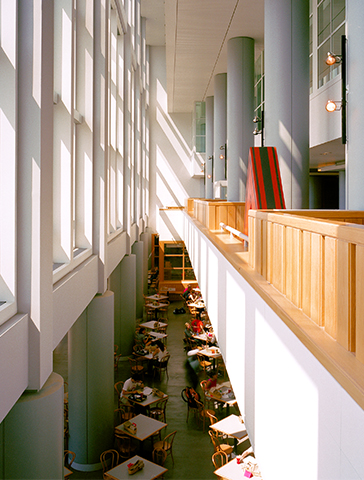
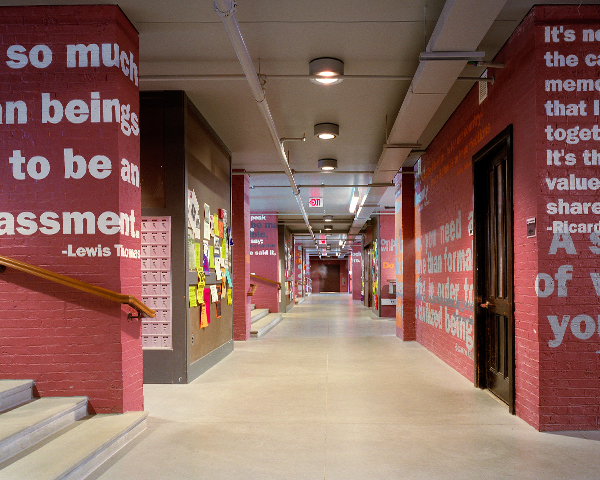
The design for the campus center is organized to reinforce these paths and establish the facility as a locus of activity along these routes — at once a destination and point of passage and casual interaction. The primary procession through the facility follows the terraced grading of the site. Visitors approaching from the north flow through a new arcade, designed as an extension of the existing building, into entries at Palmer’s lower level and move south through a series of “streets” lined with shops, student mail and information boards. At the end of these paths is a light-filled lounge overlooking an atrium with views opening out to the south. A generous flight of stairs leads further down to a dining room which opens south onto a terrace and lawn. Multiple entries are provided at this level for those approaching from the south.
The adaptation of an existing building is appropriate for a campus center, providing discovered places and lived-in spaces for a mix of uses. As a form of generic loft building — with repetitive, generous spaces readily adapted for multiple uses — Palmer provides for many aspects of the campus center program. These spaces are juxtaposed with open and flowing spaces appropriate to the new construction and constituting the south face of the building as a whole.
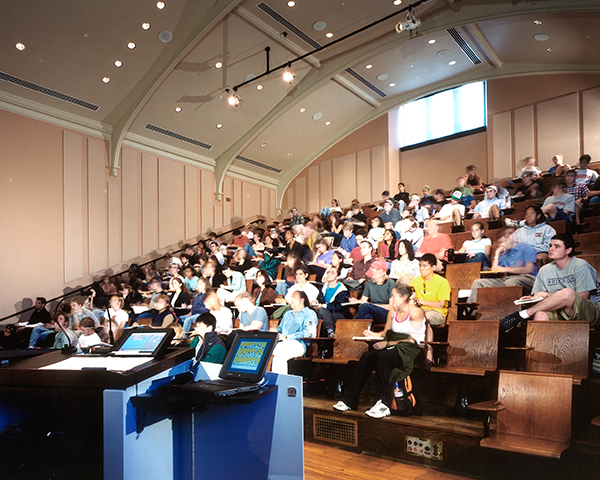
Frist’s state-of-the art academic spaces include new classrooms outfitted with extensive audiovisual systems; one was restored with the original seating and a display of the room’s original scientific apparatuses, while another retained its original vaulted and ribbed plaster ceiling but was completely transformed to house a film and performance theater. Frist also offers a home to Princeton’s East Asian Library and Gest Collection.
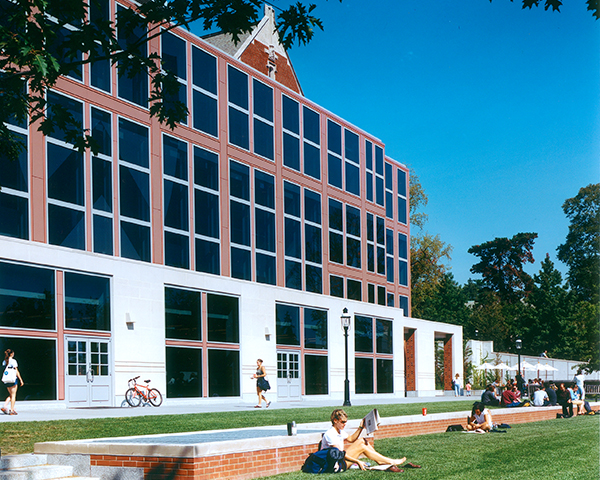
The new arcade and multiple entries at the north face make more public the rather private and closed façade of Palmer, while respecting the beautiful quality of the Jacobean style of its architecture. But there is no ambiguity between new and existing in the complex. The south, window-walled façade cloaking the wing of new construction represents the singular nature of the Frist Campus Center — a communal entity and a place of community. At night the lighted interior is opened-up, displaying multiple architectural layers and a rich mix of activity.
April 19th, 2017

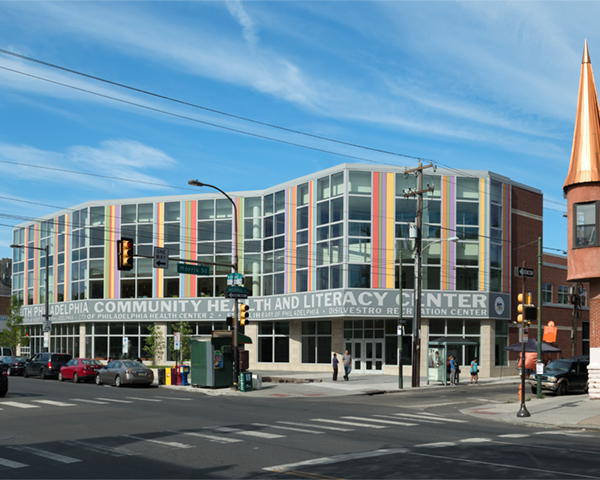
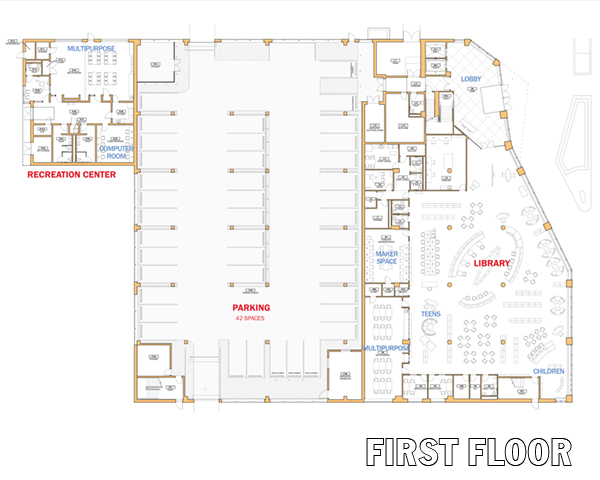
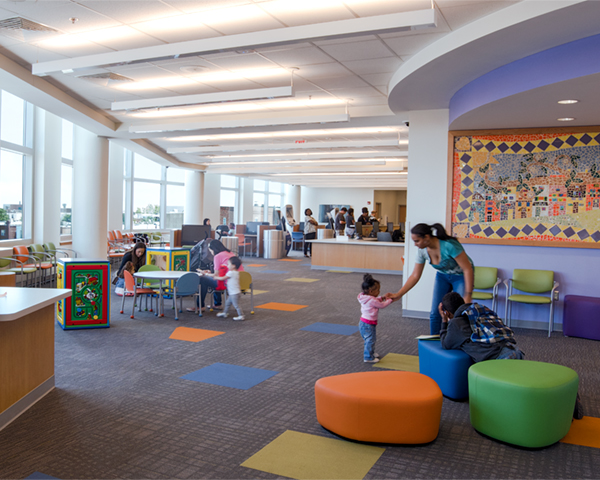
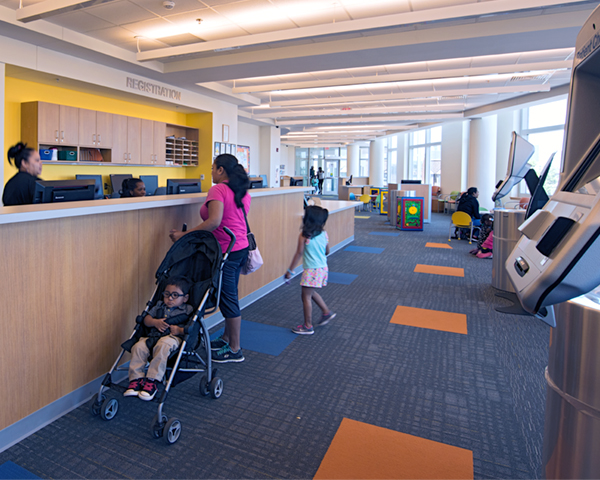
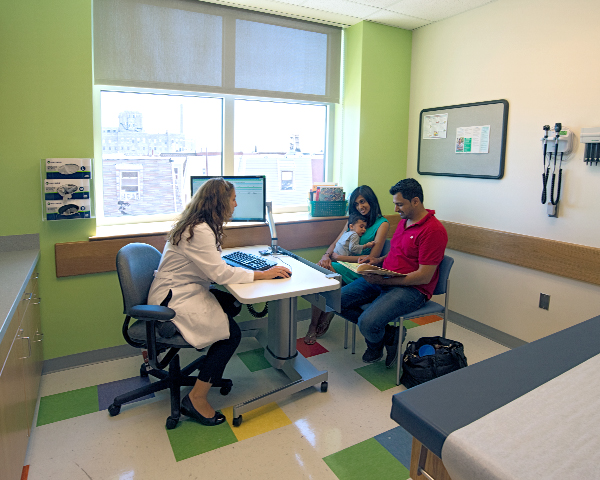
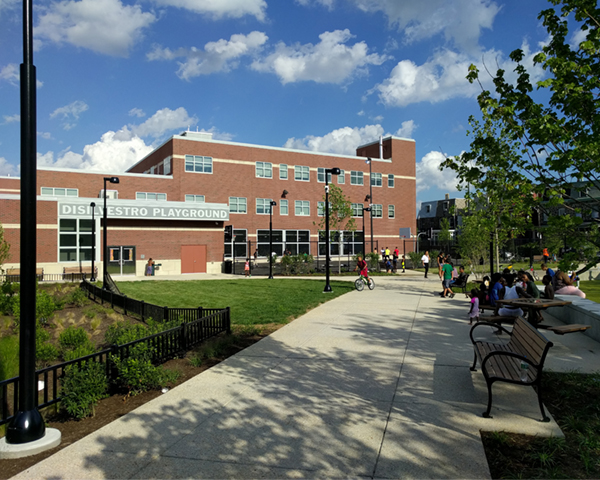
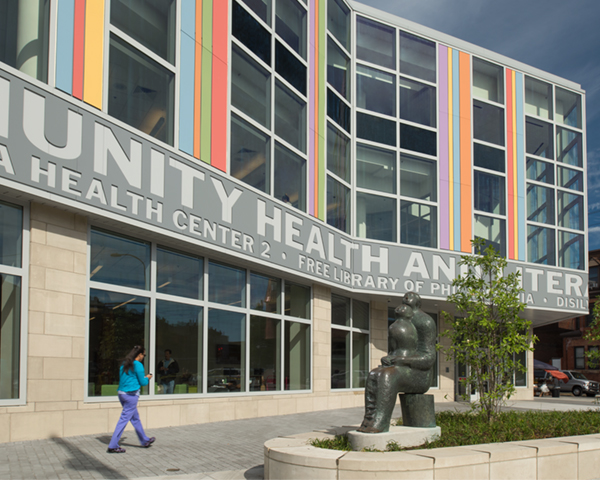
The Children’s Hospital of Philadelphia (CHOP) joined with the City of Philadelphia in a public-private partnership to create the new South Philadelphia Community Health and Literacy Center. This innovative facility combines a City Health Center, a CHOP primary care practice, a branch of the Free Library, and a City recreation center with playground. The Center serves an ethnically diverse population from the surrounding communities, many of whom are recent immigrants. The mix of uses enables joint wellness programs combining health education, clinical treatment, and physical activity. The project is LEED Silver certified.
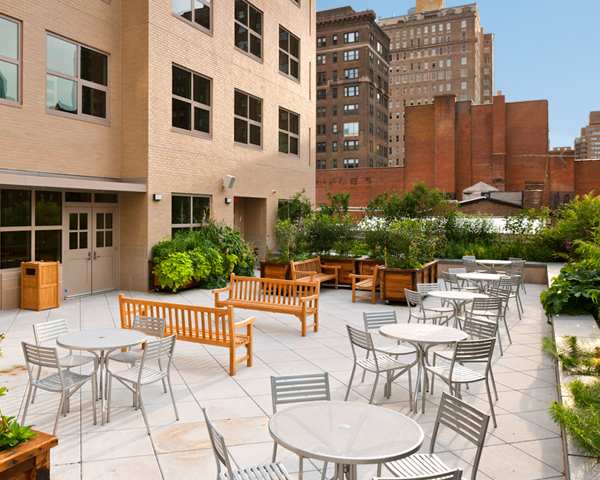
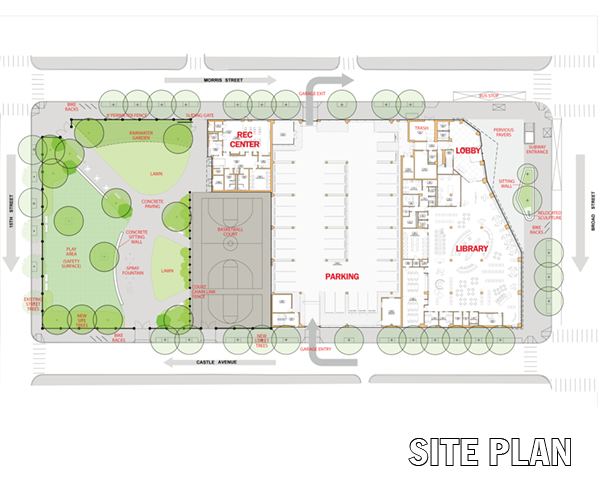
The site — extending from Broad Street to 15th Street and from Morris Street to Castle Avenue — is surrounded on three sides by 19th century townhouses. Broad Street is characterized by a vibrant mix of activities and uses. Originally lined with grand houses, it’s evolving as home to commercial activities and institutions that benefit from the high visibility and proximity to transit. The Center angles back at the corner of Broad and Morris to form an entry plaza, with a sitting wall and planting bed extending from an entrance to the Broad Street subway. “See the Moon,” a sculpture of mother and child by Evelyn Keyser, sits at the south end of the bed and addresses pedestrians on Broad Street. Enclosed parking is provided on-site for staff.
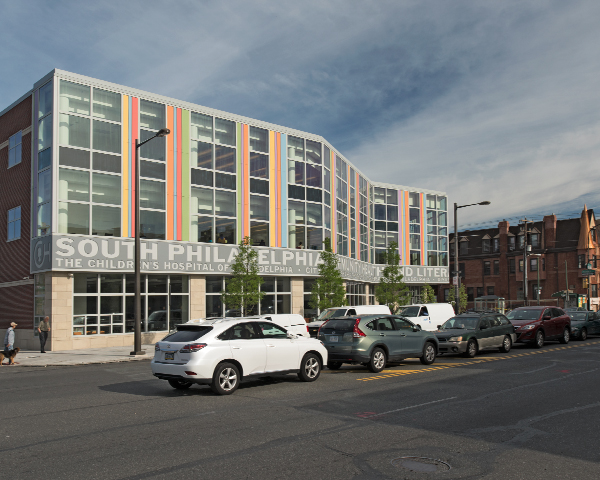
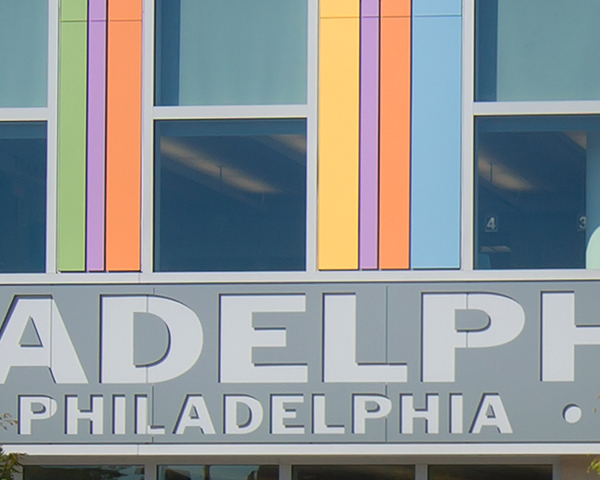
The Broad Street façade is highly transparent to engage passersby. The upper two stories containing the clinical spaces are cantilevered slightly to disengage from the column grid, enabling a rhythmic array of vertical glazed curtainwall units and striped metal panels. The panels display rainbow colors in an animated mix, suggesting the vibrant multicultural nature of the community. A continuous aluminum plate signband with punched-out letters identifies the building while adding a contrasting horizontal element. At street level, large windows between cast stone piers give views to and from the library. Together, these elements bring civic scale, individual and collective identity, and a touch of fun. Meanwhile, facades facing the residential streets combine more traditional red brick and punched window openings. A cast stone base and belt courses provide horizontal accents.
Inside, a common circulation core serves the library and clinical spaces.
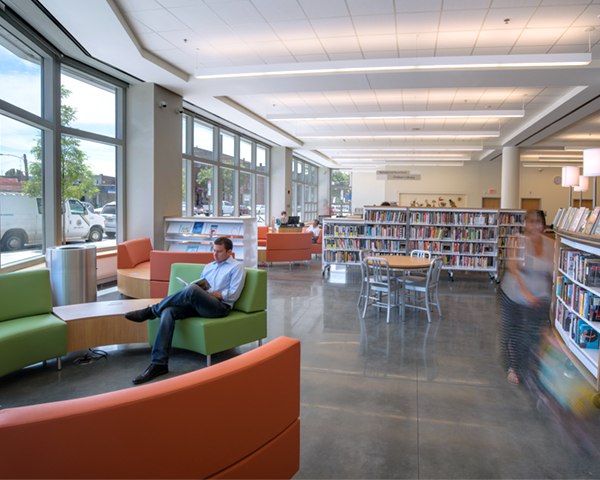
The Library is the first of the City’s Building Inspiration: 21st Century Libraries Initiative, whose goals are to reestablish the Library as a key resource and “portal to learning, public services, economic opportunity, recreation, and community engagement.” The library has general seating arrayed along the Broad Street side as well as clusters of flexible seating and collections defining areas for different age groups and activities. Enclosed spaces include a dividable multi-purpose room and a combination computer lab and “maker space.”
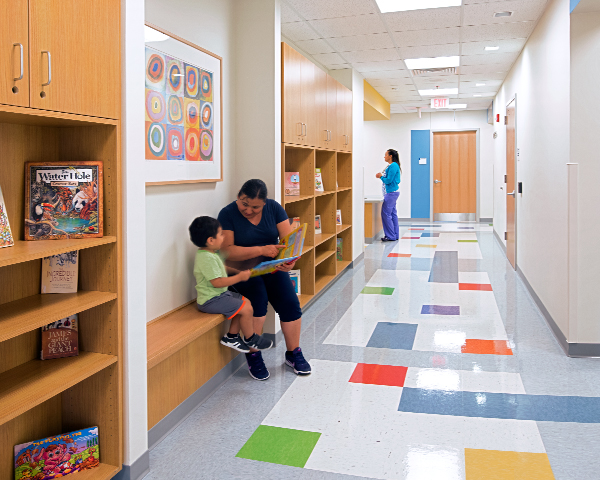
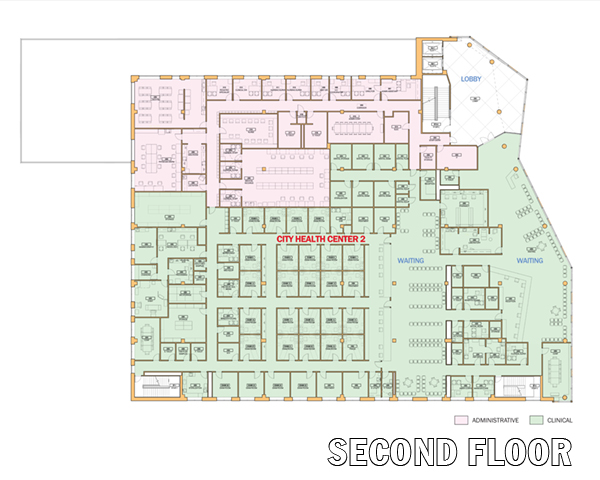
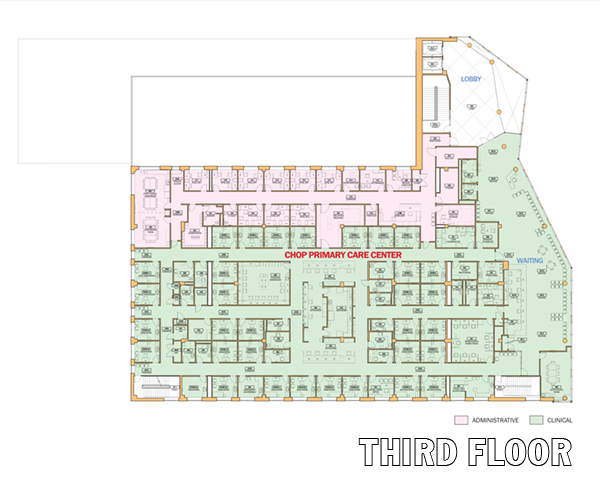
The clinical floors above are served from lobbies connected by a double-height space overlooking Broad Street. Waiting areas also overlook Broad Street with services organized along color-coded corridors extending from the waiting areas. Staff areas have discreet entrances from the lobbies and are separated from patient areas.
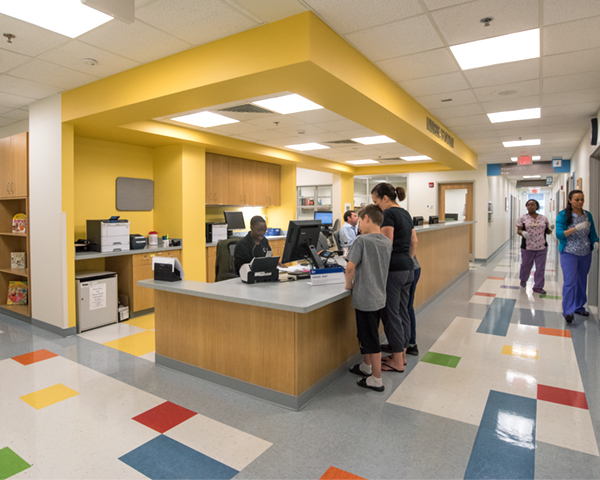
The City Health Center includes a pharmacy, dental suite, and radiology suite in addition to exam rooms and counseling spaces. Patients, often walk-ins, are screened in the outer waiting area and then directed to the appropriate section of the inner waiting area.
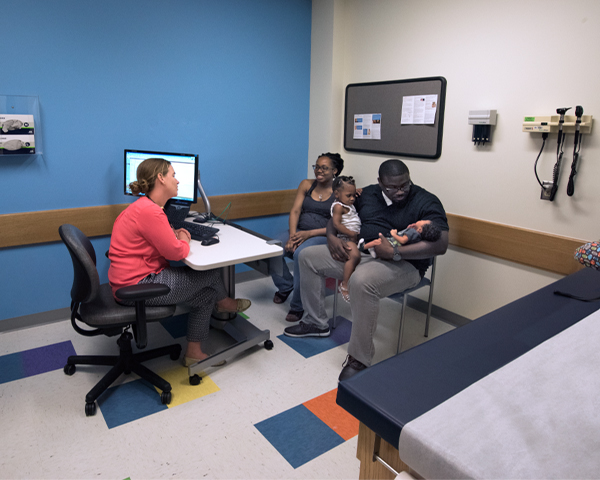
The upper CHOP floor contains exam rooms with a central nurse station. Patients are received in a single waiting area and then escorted to the appropriate exam room.
The recreation center houses a multipurpose space and computer room used by students in afterschool programs. The rec center, basketball court, and playground engage the surrounding residential neighborhood.
Photos and drawings by VSBA Architects and Planners
April 19th, 2017

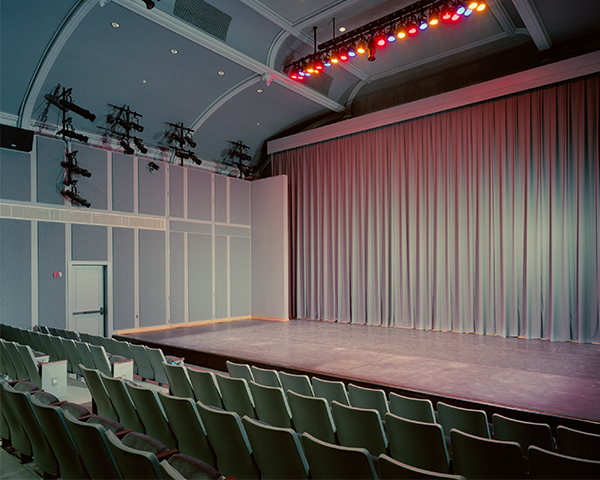
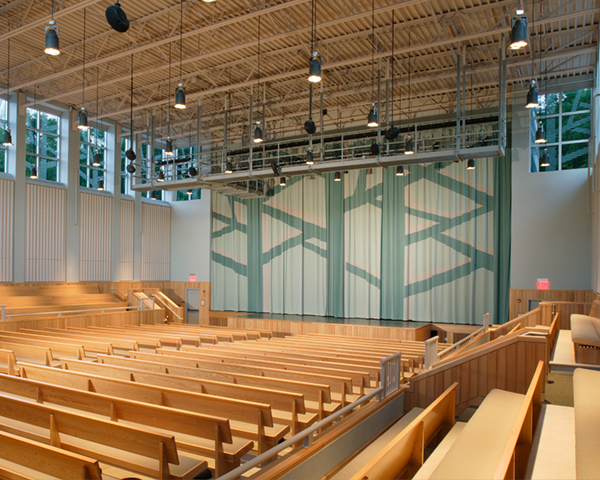
VSBA designed this multipurpose venue for the private Roman Catholic Stuart Country Day School. The program combines four disparate uses: chapel, auditorium, performance space, and communal center. For such a multi-use facility, our design required thoughtful compromise and balance — mediating requirements for staging options, seating configurations, acoustics, site lines, and daylight control for various program uses.
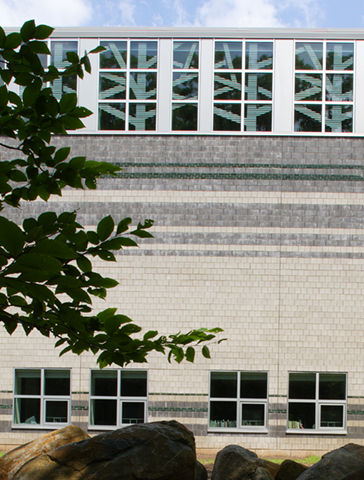
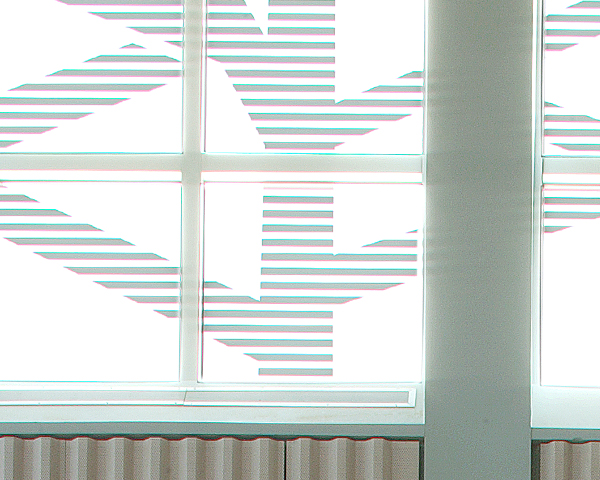
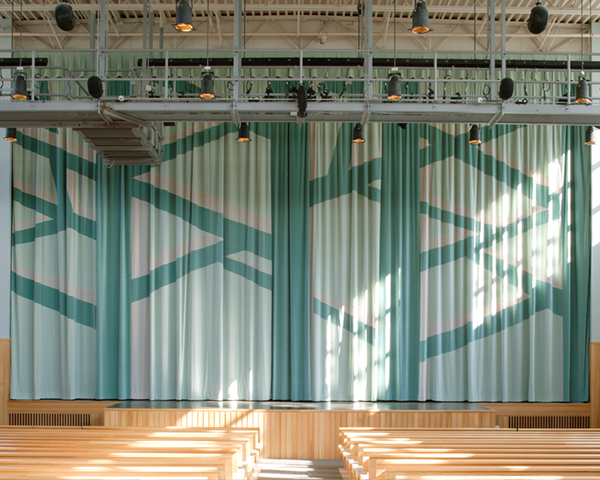
To enable music, theater, and spoken word uses, reverberation time is adjustable through the use of fabric drops. Site lines are balanced, both horizontally and vertically, to accommodate different uses. Ample natural light via clerestory windows can be controlled using shades. The representative tree branch pattern across the clerestory windows and stage curtain connects to the campus’s forest setting.